eProcurement or Avoidance?
With all the promise of cost savings and departmental customer service,
why isn't eProcurement taking off in higher ed?
Massachusetts-based Aberdeen Group has been benchmarking Internet-based procurement
automation, or eProcurement, since 1998, and has found that industry-wide, these
systems today are quietly outperforming the earlier implementations. Good news
for markets, in general.
In its December 2004 eProcurement Benchmark Report, a mixed-market study,
the Aberdeen Group reports that on average, enterprises reported that eProcurement:
- Reduced off-contract (“maverick”) spending by 64 percent
- Reduced prices by 7.3 percent for spending brought back onto contract
- Reduced requisition-to-order cycles by 66 percent
- Reduced requisition-to-order costs by 58 percent
- Increased total spending under management of procurement group by 20 percent.
Each new dollar brought under management can yield 5 to 20 percent cost reductions
Underneath all the procurement-speak, it’s easy to see that these are
significant gains in terms of cost and time saving advantages that could be
important to higher ed. And given compliance and regulation issues, you’d
expect higher ed institutions to be eager to leverage the efficiencies of eProcurement
systems. But here’s the real head-scratcher: With these sound performance
statistics—and all the advantages touted by eProcurement software companies
and ROI-conscious business units happily running eProcurement systems—what’s
the holdup in higher education? Why isn’t eProcurement taking off to save
institutions money and improve customer service to departments?
Aberdeen reports that in any market, there are challenges to success in eProcurement.
Topping the list are: 1) Supplier enablement. A surprising aspect of working
with eProcurement systems is that it’s more difficult to cultivate relationships
with suppliers than one would expect. 2) User adoption. Getting departmental
users to accept a new system is often a hard sell. 3) Budget. The initial commitment
to eProcurement stops some institutions cold.
For laggards, Aberdeen has a few practical suggestions:
1) Take the eProcurement program to executive leadership ASAP.
How many times have you heard discussions of strategies to get “a seat
at the table”? Aberdeen suggests, “If possible, create a crisis
situation by including examples of competitors that have successfully leveraged
eProcurement.” Cagey.
2) Leverage supplier networks and catalog hub services whenever possible.
And certainly, higher education can draw on consortia and other networking models
more effectively than other markets do!
3) Define basic performance goals and reporting schedules.
Aberdeen advises, “Work with the eProcurement solution provider to establish
reports and track these metrics on a regular basis.” In the higher ed
market, a handful of benchmarking efforts are getting off the ground, including
one facilitated by education market leader SciQuest, which is compiling benchmarks
in higher education as well as hosting an Innovator’s Circle for leading
institutions to share data.
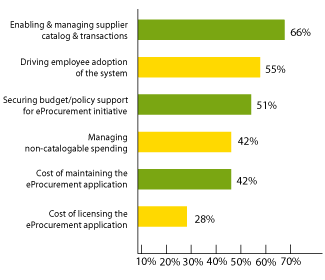
A mixed-market study offers hard evidence about the real challenges to successful eProcurement initiative. In rough order, the top three: 1) supplier enablement, 2) user adoption, 3) budget for the initiative.