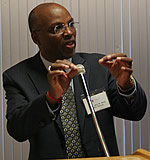
Jerry M. Harris
This month Stanford University (CA) officially opened the Stanford Center for Computational Earth and Environmental Science (CEES), a research partnership of Stanford’s School of Earth Sciences (SES) and affiliates from the Stanford Computer Systems Laboratory (CSL), government, and private industry. Stanford Professor and CEES Director Jerry M. Harris hosted a dedication ceremony June 20.
“Our mission is to enhance the capacity for large-scale computational research for earth and environmental science,” Harris explained. “A driving force for this is the fact that, here at Stanford, we have some of the world’s best scientists, and across the street in Silicon Valley are some of the world’s best computer designers and builders.”
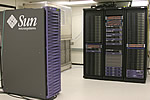
CEES High Productivity Technical
Computing Center (HPTC)
The center is a collaboration among the earth sciences and computer sciences communities and will serve as a portal to computational geosciences featuring access to CEES Grid, a powerful computational resource. The center will take on the most complex computational problems surrounding analysis, simulation, and prediction of geologic processes and systems, while working toward significant advances in relevant computing technologies.

Scott McNealy
The chief Silicon Valley partner, Sun Microsystems, contributed hardware, software, and program support for the new High Productivity Technical Computing Center (HPTC). Sun founder and chairman Scott McNealy, who began his entrepreneurial career while a Stanford student, was on hand to help celebrate the CEES launch. Sun donations for CEES have amounted to $3 million in hardware and cash. A major affiliate, Cisco Systems Inc., contributed $250,000.
Other CEES affiliates include Civil and Environmental Engineering at Stanford, 3DGeo of Santa Clara, CA, and the U.S. Geological Survey in Menlo Park, CA. USGS Senior Research Geologist Kenneth Peters gave one of the technical demonstrations, “Modeling the Geohistory of Petroleum Systems,” which illustrates the value of four-dimensional models (where the fourth dimension is time).
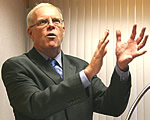
John Hennessy
Stanford University President John Hennessy applauded the effort and reflected on broader goals. Hennessy put it simply, “If you want to solve big problems – important, critical problems to human society and to our environment – you need big computers.”