Campus Briefs
:: NEWS
WORKING WITH WIKIPEDIA. While some institutions may be considering a ban on Wikipedia
(www.wikipedia.org) as an acceptable source of academic information, Purdue University (IN) Assistant Professor of
Communication Sorin Matei says nixing the online collaborative encyclopedia isn’t the answer: “Wikipedia is here to
stay and, despite penalties, people are likely to continue using it.” Matei recommends using Wikipedia as a search engine
and springboard to other resources, while staying on the lookout for possible errors and biases. Another wiki effort, Citizendium
(www.citizendium.org), is aiming to improve
on the Wikipedia model by adding “gentle expert oversight,”
and requiring contributors to use their real
names.
SCANNING FOR GOOGLE. Princeton University (NJ) will become the 12th major university to participate
in Google’s project to scan the most famous literary works in the world and make them
searchable over the internet. Princeton’s library system has agreed to digitize about 1 million books in the public domain.
A WIDE ARRAY. With the ambitious goal of providing WiFi powerful enough to function as the primary network
for students and faculty, Brigham Young University-Idaho is deploying a Xirrus array that will handle
voice, video, and data communications throughout the campus. Each unit in the array combines the wireless LAN
switch, integrated access points, and a multi-sector antenna system in a disc-shaped device designed to speed deployment
and adjustments for scalability.
PORTAL EVOLUTION. What do you do when you’ve got a great portal that
works just fine? At Western Michigan University, you ask students and other users how to make it better. The GoWMU
portal is a seamless integrated environment via which users have accessed enterprise applications
since fall 2005. But faculty, staff, and students continue to shape its usability. Read
more here.
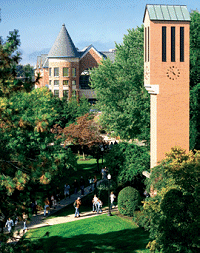
LAND OF THE APPLES: Wilkes University goes all-Mac.
ALL YOUR APPLES IN ONE BASKET? Over the next three years, Wilkes University (PA) will make the switch to become
an all-Mac campus. Though nearly all of the university’s computer labs are
currently Mac-centric, the commitment to replenish and upgrade existing computers will cost
$1.4 million.
:: PEOPLE
CIO TRANSITION FOR WAYNE STATE. CIO John Camp
retired from Wayne State University (MI) in January, after 21 years in IT leadership positions
there. (See CT’s interview with Camp, page 16 of our magazine.) WSU received numerous awards during Camp’s
tenure as CIO, including Sun Microsystems’ designation as a Center of Excellence
for Administrative Systems, and recognition as a 2006 Campus Technology Innovator. (To
enter this year’s Innovators competition, see page 6 of our magazine.) Patrick Gossman has assumed the role of
Wayne State’s interim CIO.
For daily higher ed news, go to campus-technology.com/mcv/news/