The Evolution of Online Student Recruitment
A Q&A with marketing guru Bob Johnson
- By Linda L. Briggs
- 02/19/09
Tough economic times call for harder scrutiny of marketing dollars, among other belt-tightening measures. To help institutions hone in on the best use of marketing dollars, Campus Technology talked with higher education marketing expert Bob Johnson. Johnson has been studying, writing about, and lecturing on student recruitment practices since the early '80s and now consults with colleges and universities. His focus has shifted to online marketing in higher ed. "At some point," he said, "[universities] stopped asking me how to do a better view-book. [Now], people are interested in how to make Web sites stronger for recruiting."
In this first segment of a two-part interview, he talks about new ways in which technology is being used to connect with students and parents--and how students use technology to find schools. Johnson also discusses why putting excess effort into a school's home page isn't the best use of online marketing funds. Johnson blogs about the topics discussed here, and much more, at bobjohnsonblog.com.
Campus Technology: What are some new ways in which technology is being used in higher education to reach prospective students?
Bob Johnson: The really hot items seem to change every two or three years and then get adopted into the system. Without a doubt, the hot item now [is] Web 2.0--creating interactive Web sites and allowing user-generated content through blogs....
"Hype marketing" is the way colleges and universities used to talk about themselves in traditional view-books. It doesn't carry a lot of weight anymore, because every college and university was something of Lake Woebegone. That's what I call it. The Lake Woebegone way of marketing has gone out of style now. People just don't accept it. They see through it right away.
So blogs became big in '05 and '06, even though plenty of schools don't have them to this day. Some people think they're out-of-date and passé. I think that's nonsense, measured by how many people read blogs on a regular basis. It's pretty extensive.
The best example of [blog use in higher ed] is the very first page of MIT's admissions site. When you go to MIT's admissions page, the very first thing you see is a series of blogs by students and staff at the school--the only college or university I know that puts blogs up quite that strongly right at the beginning. I visit a lot of sites, but that's the only place I have seen blogs used in that way. Even the Director of Financial Aid has a blog.
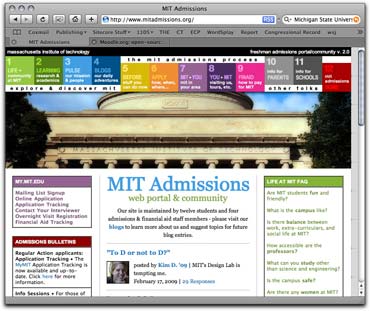
CT: I suspect that in this climate, that's a very popular blog.
Johnson: Right. So blogs are the early stage of getting into interactive Web 2.0-type content. Now the hot ticket is social networking sites and social media. People are exploring the best ways to use sites like Facebook, MySpace, and even Twitter. If you scan the link-of-the-week selections that I have on my Web site you'd find that some are now referring to Twitter sites.
That's really ahead of the curve because, statistically, there aren't that many people using Twitter compared to Facebook or MySpace. But colleges and universities to some extent are moving into that right now. I think how much all that contributes to the actual increase in the application pool and ultimate conversion to attend a school--I've not seen any hard data on that at all. But it does make sense to me that colleges and universities are starting to pay more attention, because people are searching out information about schools on sites like Twitter.
CT: You have an interesting list on your Web site of college and university presidents who are blogging. What value does it bring to a college or university when a president blogs, "tweets" on Twitter, or otherwise reaches out via technology?
Johnson: It depends on the personality of the president, but let's assume the president is very outward-going and understands that part of their job is to be a visible symbol of the college or university--the kind of president who welcomes getting out and talking to groups of people, being in front of people and maybe even likes going out and raising money.... If you have that kind of personality, the blog is an excellent place to speak frankly to the public and to the internal community about issues that are important to the school. I can't quantify the benefits but they are definitely there.
Sure, it drives some PR people crazy--the idea that some presidents just blog and don't clear with anybody first. It's done in different ways. If you look at my list, there's no pattern regarding the type of institution. There are two-year schools and mega-universities like Michigan State University, Arizona State.... There are Christian colleges, there are all kinds of different schools.
It's just another way to communicate. If the president is comfortable doing it, and can commit to doing it on a fairly frequent and likes to communicate relatively informally with people, it's a natural thing to do.
I have not yet done a Twitter search so I honestly don't know if there are any presidents doing Twitter. I suspect there probably are. There are lots of colleges and universities with Twitter sites. I don't know of any individual presidents yet. Right now, I think blogging is much more accessible.... Twitter hasn't gone mainstream yet.
CT: How can an institution's Web site itself best be used for reaching students? What's happening there?
Johnson: Well, the value of the organizational Web site is clearly diminishing.
For many places, it's no longer the primary source for information about a school. Today, you have everything from RateMyProfessors.com to Wikipedia. Go on Google--which more than half of people using the Web will do--and search for almost any school in the country. See what comes back on that first Google page. The school's Wikipedia site will often be in the top five sites that come back. Eight times out of 10, it will be on the first [search results] page.
Here's another thing you'll see eight times out of 10 in a Google search. Listed right under the homepage [in the search results] will be eight other pages by which you can enter the institution's Web site.
If you stop and think about that for a second, about all the time and energy put into the home page--it's diminished if one of those links gives you the option to go right to admissions. If I'm a potential student, I won't go to the home page; I'll click on admissions.
CT: So lots of students are bypassing the home page and jumping deep into the school's site immediately?
Johnson: Absolutely. If you have an analytics program properly set up, you can measure that traffic to your site by tracking by month how many new, first-time visitors came to the admissions page, and where they came from.
CT: To respond to that, I assume schools need to adjust their admissions page design accordingly, realizing that it might be the first thing a student sees?
Johnson: The admissions page really needs to stand alone as a place of first entry. The example I gave earlier is the M.I.T. admissions page. Many other colleges have made that shift now... Develop the admissions page as if a person will come here first. That's the smart thing to do anyway.
In the second installment in this two-part series, we'll explore smarter ways for schools to spend their marketing dollars. Find more information on recruitment and retention in our special Solution Center here.