High Tech Law Institute Remembers 100th Anniversary of 1909 US Copyright Act
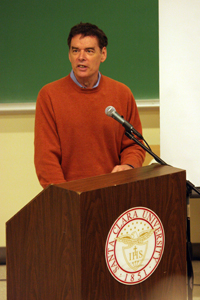 At Santa Clara University, the centennial of the repealed 1909 Copyright Act did not slip by unnoticed. In fact, it was commemorated this past Thursday with a full-day conference joined by distinguished legal scholars and copyright experts. Held in a large lecture hall on the SCU campus, Santa Clara Law's High Tech Law Institute (HTLI) sponsored the booked-to-capacity event that examined historical perspectives on the 1909 Act and the evolution of copyright law with consideration of key issues and trends including the emergence of new media--from the "piano rolls" causing controversy at the time of the 1909 Act to digital media today.
Notable keynotes and session leaders from government and industry included Marybeth Peters, US Register of Copyrights; David Carson, General Counsel, US Copyright Office; and William Patry, Senior Counsel for Google (above). Plenary sessions also included more than 20 academic panelists from higher education institutions across the country.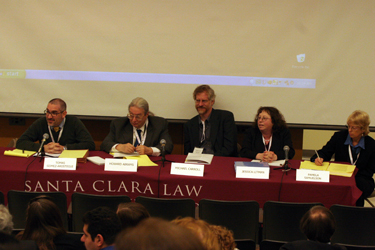 A panel on "Copyrightable Subject Matter, Infringement, and Remedies" included examination of the expansion of copyrightable materials to include new media. (above, left to right: Tomas Gomez-Arostegui, Lewis and Clark Law School; Howard Abrams, University of Detroit Mercy School of Law; Michael Carroll, Villanova University School of Law; Jessica Litman, University of Michigan Law School; and Pamela Samuelson, UC Berkeley School of Law)
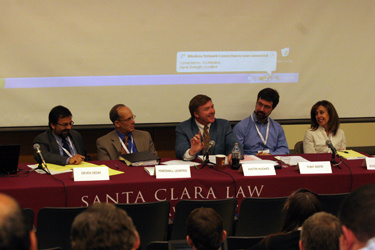 An "Authorship and Ownership" panel focused on the concept of ownership with a look at works for hire, term of copyright, and the renewed interest in the role of "moral rights." (above, left to right: Deven Desai, Thomas Jefferson School of Law; Marshall Leaffer, Indiana University School of Law; Justin Hughes, Yeshiva University Cardozo School of Law; Tony Reese, University of Texas School of Law; and Roberta Rosenthal Kwall, DePaul University College of Law)
"Exclusive Rights and Limitations" were discussed in detail in two afternoon sessions. Papers from session presenters are posted on HTLI's Web site.
About the Author
Mary Grush is Editor and Conference Program Director, Campus Technology.