Eastern Mennonite U Adds Largest Solar Block in State of Virginia
- By Dian Schaffhauser
- 11/29/10
Eastern Mennonite University in Harrisonburg, VA recently flipped the switch on a new solar installation that has the capacity to generate 104.3 kilowatts of electricity.
The university, which has about 1,600 students, now has 328 photovoltaic panels on the roof of the campus library. According to university representatives, the PV installation is the largest in the state. If investors can be found, a second project is planned that will consist of a 300 kW array of solar panels on raised canopies that will also provide shade to a campus parking lot.
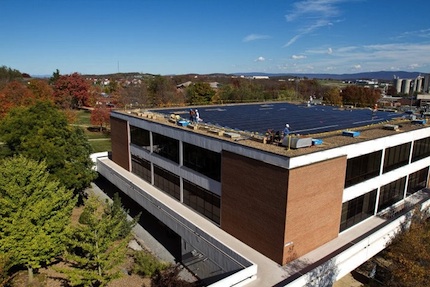 |
| Eastern Mennonite University's solar installation includes 328 potovotaic panels. Photo by Jon Styer. |
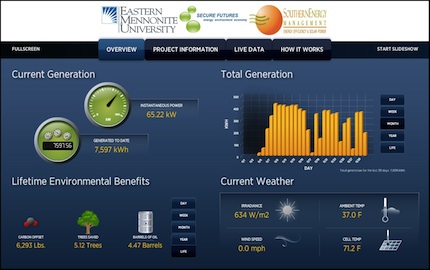
A portal provides real-time and historic data, including kilowatts generated to date on the project (4,555 at the time of this writing), total generation by period (day, week, etc.), current weather conditions, and a benefits equation that shows the impact of using the generated solar power versus barrels of oil, greenhouse gas emissions, and trees saved. According to information posted on EMU's solar project site, the solar installation is expected to eliminate 6,000 tons of emissions over the projected 35-year life of the panels.
 |
The project was designed and developed by Secure Futures, a Virginia company that also set up Community Solar, a limited liability corporation consisting of local investors that would purchase and own the solar panels. The institution entered into a 20-year power purchase agreement with Community Solar to buy the solar-generated electricity at a price equal to the rate it's paying for power from its current provider. The agreement requires the school to pay in advance for 10 years of that electricity output to reduce the expense of financing the project. In return, Community Solar will pass savings back to EMU as an annual credit. The project also received economic stimulus funds.
The project used panels from SunPower, and installation was performed by Southern Energy Management, which will also handle on-going maintenance and monitoring.
"Our planet does not have unlimited natural resources, and it is imperative that we utilize clean renewable energy such as solar as part of the university's long-term commitment to creation care and environmental sustainability," said university President, Loren Swartzendruber, at the formal launch of the completed project.
"Any student I've talked to values this sign of commitment to sustainability and creation care on campus," said Benjamin Bergey, a senior from Perkasie, PA and co-president of the Student Government Association. "... [W]e as students are grateful to be at a school of integrity, with consistency between words and actions."
About the Author
Dian Schaffhauser is a former senior contributing editor for 1105 Media's education publications THE Journal, Campus Technology and Spaces4Learning.