NYU Stern School of Business Helps Bolster iPad Coursepack Features
- By Dian Schaffhauser
- 05/26/11
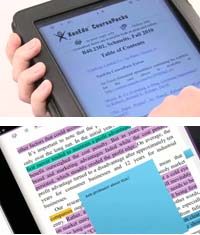
Version 1.5 iOS-based software lets users highlight and annotate materials. |
New York University Stern School of Business, which has been testing the use of coursepacks on Apple iPads and iPhones since fall 2010, is working with the publisher of those coursepacks to add additional materials. Stern teamed up with XanEdu Publishing to add multiple features to the digital materials. The iPad app initially appeared in the iTunes store in December 2010.
Version 1.5 of the iPad software offers:
- Enhanced PDF editions of the material to allow the student to own the materials "forever" and to enable its viewing on non-Apple devices, such as a computer;
- The ability to add coursepack media to the school's Blackboard sites; and
- A way to highlight, annotate, and search material through the iPad app.
A coursepack is a custom compilation of copyrighted and instructor-developed resources specified by the faculty member for a class. XanEdu has a database of licensed materials, such as textbook chapters, and handles management of copyrights and royalty payments of those materials for the institution.
The school reported that the average cost for coursepacks nationally is $25; it didn't specify how much the typical coursepack costs in its own courses. Those digital coursepacks may contain Harvard Business Cases and supplementary videos, downloadable Excel files of tables and charts from those cases, executive book summaries in audio and PDF format, and ExperiencePoint organizational simulations.
To create a coursepack, the instructor submits a list of requested material to the New York U bookstore, which works with the vendor. It can be made available as a print copy, digital access key, or both and put on the bookstore shelf for students to purchase.
To develop the list of enhancements in the latest generation of coursepacks, XanEdu relied on feedback from 500 Stern students as well as students in other institutions. As a result of this student-centered approach, "97 percent of the students surveyed indicated that they would recommend XanEdu's approach to digital course materials," said Maya Georgieva, Stern's Assistant Director for the Center for Innovation in Teaching and Learning.
"Students have very specialized needs when it comes to reading class materials" said Tyler Steben, vice president of Custom Publishing at XanEdu. "We found that most e-readers fall short of these needs for classroom use. For example, our nationwide sampling uncovered a great need to support a workflow specific to the study habits of students in higher education." This led to the development, for example, of a "magic back button" that simulates the flipping back and forth of pages within a digital environment, which can be used to return to the original location when viewing an internal exhibit or footnote.
Stern and XanEdu said they expected to continue working together in the future to evolve the app. The app recently won a Campus Technology Innovators award.
About the Author
Dian Schaffhauser is a former senior contributing editor for 1105 Media's education publications THE Journal, Campus Technology and Spaces4Learning.