Open Virtual World Scenarios Test Students on Ethical Decisions
- By Dian Schaffhauser
- 10/30/12
Researchers at Iowa State University and West Chester University of Pennsylvania are creating a virtual world where science and engineering students can confront ethical issues in a virtual environment. The first simulation is set to be released on November 14 in a SciEthics Interactive project called Transgenic or TransGen Island. A demonstration event will take place on Google+.
SciEthics Interactive is a set of free role-playing simulations that tie instruction in science content with ethical decision-making. The simulations have been developed to run in the OpenSimulator environment, an open source server platform already in use at universities and schools. The simulations are intended to be integrated into science and engineering courses to expose students to the process of working through situations where ethical decision-making comes into play.
According to the developers, the virtual exercises allow participants to interact with objects that are "too dangerous, too large, too small, or too far away for contact in real life."
| | 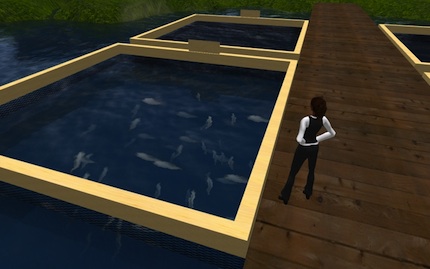
SciEthics Interactive's first exercise deals with the ethics of genetically modified salmon. | |
The first exercise focuses on the ethical dilemmas inherent in genetic modification. As part of the scenario, a fictitious company (TransGen) is manufacturing genetically modified salmon. Within the virtual environment, students will be able to pull together data, do analysis on it, and produce a report based on their findings. The scenario's authors expect that while the students are engaged in their research project, they'll have to address ethical issues dealing with data integrity, environmental impact, and animal welfare, as well as public health.
"The prospects for teaching and testing ethical behavior in virtual worlds is frequently discussed, but currently there are no simulations for posing ethical dilemmas in the fields of science and engineering," said Larysa Nadolny, assistant professor in Iowa State's School of Education and co-creator of SciEthics Interactive. "The simulations we're creating connect learners with high quality scientific content, while encouraging engagement in ethical thinking."
The TransGen Island project won second place in the category of "concept building" in a competition sponsored by the United States Army Research Laboratory, which challenged contenders to create federal virtual worlds.
Major funding was provided by the National Science Foundation and HP.
Those interested in watching a live demonstration of the project can sign up for an invitation to the release event, which takes place on November 14, 2012, at sciethicsinteractive.com.
About the Author
Dian Schaffhauser is a former senior contributing editor for 1105 Media's education publications THE Journal, Campus Technology and Spaces4Learning.