Of the more than 65 million student papers reviewed for AI writing by Turnitin's detection tool since April, more than 2 million — or 3.3% of all papers reviewed — have been flagged as containing 80% or more AI-written text, according to a news release.
Nonprofit open-ecosystem collaborative 1EdTech Consortium recently awarded top honors to six higher education institutions for their development of “innovative and bold” ed tech tools that broaden access to personalized and accessible learning.
In the first six weeks of educators using Turnitin’s new AI writing detection feature, the platform processed 38.5 million submissions, and the results — as well as plenty of feedback from educators and administrators — led Turnitin to tweak the detector and to further explain the meaning and accuracy rates of the detection scores.
Plagiarism detection software Turnitin now includes new live AI-writing detection features that “identify the use of AI writing tools including ChatGPT, with 98% confidence,” the company said.
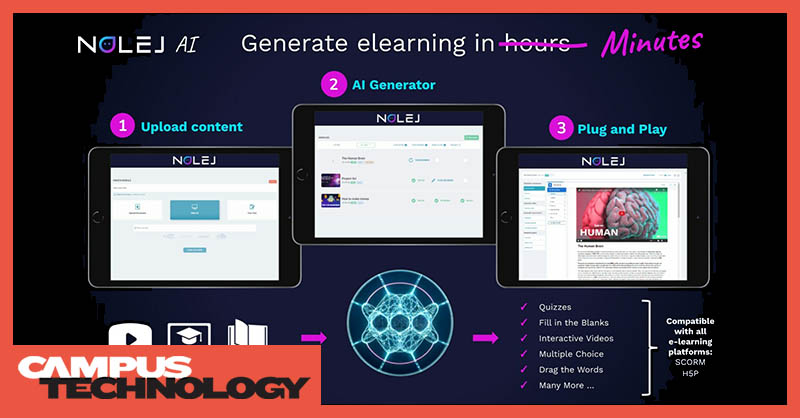
A French generative AI ed tech startup called Nolej (pronounced “knowledge”) has made publicly available its new OpenAI-based instructional content generator for educators, called Nolej AI, ahead of its official introduction at BETT in London planned for Thursday, March 30, and its scheduled commercial debut at the ASU+GSV Summit on April 19, the company's chairman told Campus Technology.

Expanded multi-modal MathGPT Platform possibilities mean any math content or curriculum can be turned into a personalized GPT-powered chatbot with interactive text, audio, and video learning, and GotIt can configure the platform to work with a wide variety of applications in math education, the company said.
Career training and aptitude assessment provider YouScience has launched a new education-to-career platform called Brightpath that helps students identify their natural aptitudes and skills, select the learning path and school coursework best aligned to their aptitudes and future career opportunities, connect with post-secondary programs matching their aptitudes and interests, find internships and jobs matching their aptitudes, and even earn CTE certifications.
Aptitude assessment and CTE solutions provider YouScience has acquired the National Center for College and Career Transitions, or NC3T, expanding YouScience’s ability to help students find and prepare for the career and college options that best fit their interests and abilities, according to a news announcement.

Turnitin has launched a new mobile app for its Gradescope assignment and grading platform that enables students to submit their assignments through any connected smartphone, the company announced this week, following a limited-access pilot in April.
1EdTech Consortium has updated its digital assessment interoperability standard with added accessibility features and improved rendering to enable greater access in large-scale testing for students with special needs, the nonprofit said in a news release.