
Among the core themes of the recently released Changing Landscape of Online Education report is that growing student demand for online and hybrid learning is moving higher education toward a multi-modal future. We spoke with Dr. Bethany Simunich, co-director of the CHLOE Project, about key takeaways from the CHLOE 8 survey and why institutions that aren't examining their online strategy may be putting themselves at a competitive disadvantage.

We spoke with Anthology Chief Product Officer JD White about his company's vision for AI as well as practical considerations for embracing AI tools in the classroom.

CT talks with Instructure's VP of Global Strategy Ryan Lufkin to learn how his company leverages partnerships in an evolving global marketplace.
What skills will students need for the workforce of the future in an age dominated by artificial intelligence? In addition to basic computer science, data competencies, and the mathematics and statistics behind AI and machine learning, there are a range of social impacts to consider: AI risk, ethics, privacy, questions of bias, etc. We spoke with Dakota State University President José-Marie Griffiths about how her institution is preparing students for careers in AI.

Tech Tactics in Education speaker Jason Simon shares how colleges and universities can better utilize data to tackle existential challenges and move toward analytic maturity across the institution.

Advertising students at the Indiana University School of Media have the opportunity to work on real-world projects for big-name clients such as Adobe and Microsoft, honing their skills as they solve complex marketing problems and craft messages for a target audience.

Here, Mark Frydenberg, a Distinguished Lecturer of Computer Information Systems and director of the CIS Sandbox at Bentley University, shares his experiences using AI in education.
As National University's chief digital officer, Alex Chimon leads both the digital and the data realms, with the strategic goal of improving student outcomes and the student experience. We talked about NU's key digital transformation goals, how the worrisome capabilities of artificial intelligence will impact Dx efforts, overcoming fear of change, and more.

A new guide for higher education from Ninjio on improving cyber defense through campus-wide training offers actionable advice for institutions’ leaders on how to translate their core competency — education — into a successful cybersecurity awareness program that reduces vulnerabilities and improves security posture across the entire campus and network.
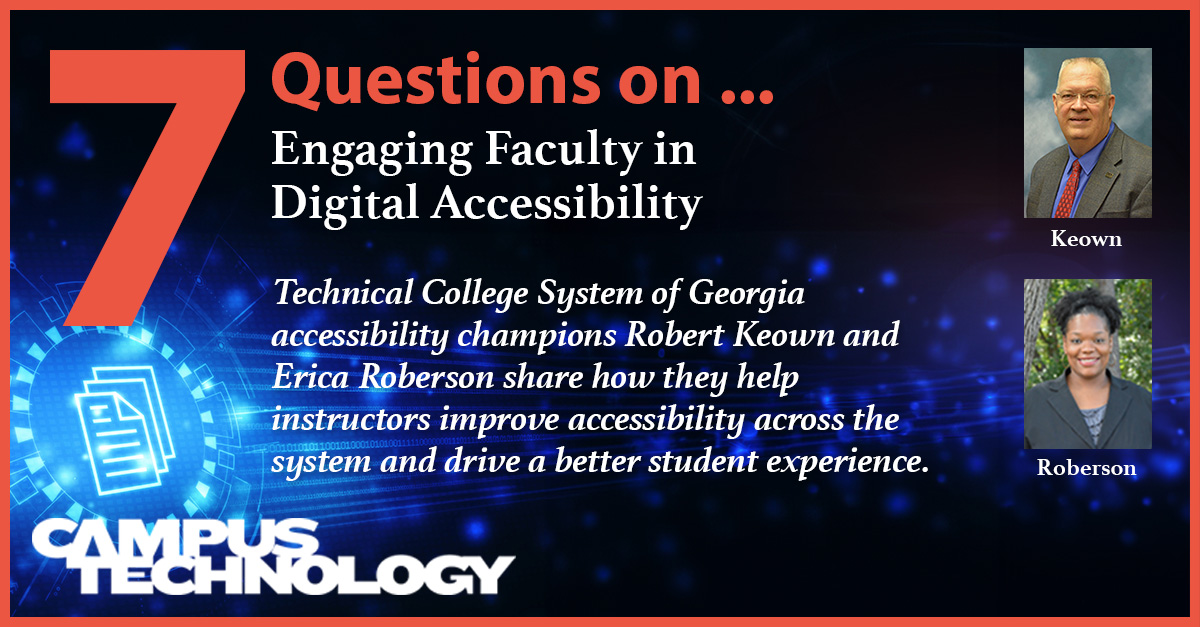
We asked the Technical College System of Georgia's accessibility champions how they help instructors create a more inclusive learning experience for all students.