Open Source: Advancing Our Digital Commons
A Q&A with Jack Suess
Not many of us think "open source" as we use today's sophisticated software. But in fact, most of that software is actually based on open source. IT leaders are recognizing the benefits of returning to open strategies and are exploring options to do that. To get some perspectives from a seasoned IT leader in this space, CT asked Jack Suess, VP of IT and CIO at the University of Maryland, Baltimore County (UMBC) — whose career path has wound its way through the many stages of open source — for his views on returning to the digital commons of open source.
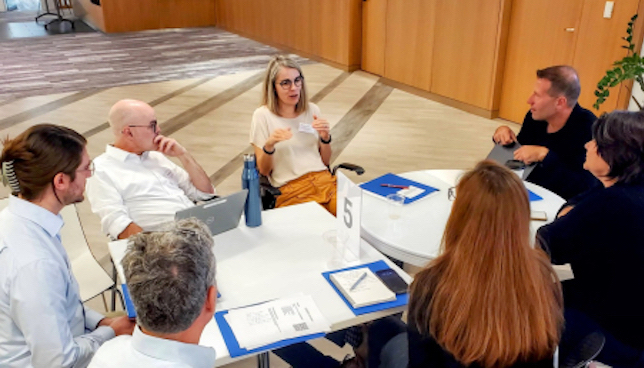 The return to open source dominates the conference buzz during a workshop hosted by Ithaka S+R and Apereo in 2025, as participants take on the challenging discussion topic of "Sustainability in Open Science and Research". (Photo by Patrick Masson, courtesy Apereo. With permission.)
Mary Grush: How has your career involved you in open source?
Jack Suess: My first work with open source dates back to the mid-to-late '80s. At that time, I was the main system administrator at UMBC. I was running a VMS cluster and a Unix environment.
To us, the world was wrapped around being able to leverage software that was being developed at universities, or national labs, or other research centers recognized for open source software. The way we got our operating systems, at least in the Unix world, was by downloading them from FTP sites so we could install the open source software locally. And so, many of our environments were running the Berkeley system distribution in Unix.
Right after that mid-'80s timeframe, MIT was releasing the Kerberos package. And Carnegie Mellon was releasing the Andrew File System (AFS) and Andrew system. All of this interesting development was taking place within the higher education community that I grew up in professionally. Both AFS and Kerberos are still in use today at UMBC.
I didn't call myself a developer. I have a math and computer science background, though I never got deeply involved in development work. But I installed and supported all this open source software and made sure it worked for faculty and students.
So, that was how I first came to experience open source. Then over time, as I got more involved in other kinds of projects in higher education, I began to see a whole range of settings where the world was being run by open source. A good example would be the early cybersecurity tools — they were often open source and had been developed and built out through many of the Unix systems environments.
And mid-career, as I got involved in the identity management community, I found that a lot of the work that Internet2 and various groups were doing with SAML, or with middleware, was released into the open source community — and picked up not just at universities in the U.S., but all around the world. I was able to watch diverse communities evolve in open source.
Grush: And now, what are some of your current experiences with open source — and your more recent observations?
Suess: I think that what has begun to happen over the past decade or so, is that cybersecurity compliance checks have made people feel a little bit concerned about open source. The questions they have are, one, who do I call if I have a problem? Do I have a vendor who can support this? And two, who do I call to get the certification that this software is done securely?
One of the perceived weaknesses or challenges in open source is that it doesn't have the same level of security [as vendor-run software]. Not so! The reality is that when you're using software that you bring into your own environment, you have a lot more control over the cybersecurity of the software than you would by using software that's run by a third party.
The other part of that is, it seems that many people think vendor support is much better than support within your community. Historically, though, I have found that the open source communities are actually on top of it all. The open source communities are always aware of security vulnerabilities and usually get patches and releases out within days, while vendors may do security updates on a quarterly basis or sometimes even longer.
Grush: So should people now re-engage more directly with open source?
Suess: Definitely. I think we should be stepping back and asking, what are some of our key goals and why might open source be an approach that we want to be more closely involved with? There's a multitude of reasons why this is timely; there are three that are pretty much staring us in the face.
The first of those three is that higher ed across the board has seen a lot of financial cuts. Some have occurred through changes in our research funding. Some we're seeing because, by and large, enrollments are down. Various U.S. states don't always see the same levels, of course, but we have seen a significant decrease in international students. And so, as we think about the impact on our budgets, open source can be a great way of being able to expand capabilities without having to spend a lot of money.
The second thing is open science. One of the goals of the U.S. federal government and governments all over the world is to do science that's transparent and reproducible. Open source software supports our creation of open science.
Part of the reason that we're asked to keep data from research projects longer than most other data is because people want to be able to go back and review the data — to find new insights they may have missed at first relative to the exact focus and design of the research. So now, when I go back and look at the data from a different perspective, I may find something that's really important that wasn't being examined initially. This open science world we now live in is driven largely by the open source community.
Finally, the third thing that really strikes me is AI. To me, AI is going to be one of the more transformative things that we'll see over the next decade. It's not unlike what the Internet was to me in the mid-to-late '80s: Soon after the Web came about, we noticed that it was becoming democratized. Everyone wanted access to this set of information resources. And, we've seen that also happen in a matter of months with AI. It's a worldwide resource, and it's not constrained to one group or another.
Figuring out how we can fully utilize AI is going to be one of the key elements that we have to be thinking about if we're going to be successful. And the more open the tools we make with AI, the more effective we can be as we craft solutions that use AI.
Grush: Who is going to emerge to lead everybody back to working and thinking again on a basis of openness? Who's looking after our digital commons over the long term?
Suess: That's a great question. I would say that while the first round of open source, if we go back to that '80s and '90s timeframe, was driven predominantly by higher ed. Today, I think we're seeing that it's being driven by several different sectors.
One sector that we're seeing worldwide is governments that want to be taking advantage of open source because they don't want to be locked in to vendor contracts. So we're seeing that a lot of our really big technical efforts, whether that's in the military, space, or other areas, rely heavily upon open source in order to be able to function effectively. There will be certain governments that are only going to want to use particular kinds of models that they have more control over or that they have more confidence in.
Similarly, huge companies like Google and Microsoft and Amazon make heavy use of open source for many of the same reasons. And that kind of thinking is also important if you are in the public sector, particularly in very large companies.
And so, the place where the leadership you're asking about will come from is growing more and more diverse.
What I think is important in the higher ed sector specifically is that we're making sure we keep our eyes on the opportunities that open source can afford us, especially as we're starting into this next great digital transformation era.
I expect that higher education won't have a problem with the fact that open source is going to be a long-term staple in the world. The question, to me, is how is higher ed going to participate in this open world in way that it will be able to leverage the capabilities that open source can provide, and really grow those capabilities to be able to use them to the benefit of society? — For increasing benefits to education, growing benefits in the research that we produce, and making what we do more consumable by the public.
Grush: What groups within the higher education community are going to be prepared first — and might be in a position to lead others?
Suess: I think there are technology units, especially at our larger research universities, that should definitely be at the table. But I think you're also going to see some of the large online universities that are thinking about how they want to bring AI to bear through courses and teaching and learning. And the hope is that we'll be able to engage people through organizations like Apereo, EDUCAUSE, Internet2, and others that bring [open source and] technology leaders together by pointing out that all this is a process that can be beneficial to our communities.
We'll also see mechanisms to organize and promote and lead change, such as the open letter that was distributed by the Apereo Foundation and other partners at Open Education Week in early March, 2026, calling for higher education's stewardship of the open digital infrastructure that supports our institutions' most strategic goals.
And we need people to be investing time to help explain how they're having success, sharing the best practices, and working together to solve some of the issues that maybe currently lack solutions. And if we do all that, I feel really confident that this will also be a win for higher ed — not just for large tech companies, governments, and other groups that have already made the decision that open source is fundamental to their long-term success. Ultimately, through these efforts, I think that the digital commons, the open source world that we live in, is going to be successful, and more recognized as such.
Grush: Is there an effort focused on preparing the next generation of graduates for open source, not only in computer science, but in other fields as well?
Suess: We have seen some schools do a fabulous job of integrating open source into curricula, so that if you're taking, say, a software engineering course, one of the things that you might be trying to do is to be active in open source. Here at UMBC, a lot of our computer science faculty leverage open source as part of the instructional training that we're offering, as part of the work that they're doing in collaboration, or as part of their research.
Faculty and students are using a lot of open source tools. They're using Linux. They're using the open source editors. They're using open source tools for managing code.
And so, there is an attempt to prepare students for openness, but I what I'm really excited for is our initial thinking about some of the new AI coding tools. They are going to help students pull down the code and create their own added functionality — new functionality that might actually get added back into the code. I think it's going to be exciting when we see that we're creating a whole new population of students who want to be jumping in and learning to code in environments that are going to allow them to be adding their own new functionality and capabilities.
And to me, I think powerful, open AI tools are going to help students jump their game, so to speak, to a new level, as true open source contributors who will advance our digital commons.
[Editor's note: See also our July 2025 article on "A Return to Openness".]
About the Author
Mary Grush is Editor and Conference Program Director, Campus Technology.