Epson To Ship Voice-Amplifying Classroom Projectors
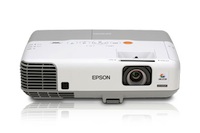
The PowerLite 915W and 905 include mic ports and 16 watt speakers for voice amplification. |
Epson has introduced two LCD projectors with networking and voice amplification capabilities. The pair debuted at the FETC 2011 conference being held this week in Orlando, FL.
The new projectors include the PowerLite 915W, with a resolution of 1,280 x 800 (wide XGA, also known as WXGA), brightness of 3,000 lumens, and contrast ratio of 2,000:1; and the PowerLite 905, an XGA-resolution (1,024 x 768) projector with a brightness of 3,200 lumens and a contrast ratio of 2,000:1. Both projectors also off LAN connectivity via RJ-45 or an optional wireless adapter.
For voice amplification, the PowerLite 915W and PowerLite 905 feature a 16 watt speaker and a microphone input.
Other features common to both models include:
- Line and graph pattern templates for classroom instruction;
- 1.6x optical zoom;
- ±30 degrees automatic vertical keystone correction;
- ±30 degrees manual horizontal keystone correction; and
- A virtual remote that controls power, volume, video sources, mute, and other functions from a Web browser.
AV ports on the PowerLite 915W and the PowerLite 905 include dual RGB (mini D-sub 15-pin), HDMI, S-video, composite video, RCA audio in, RGB out (mini D-sub 15-pin), and separate stereo mini jacks for audio out. For control, they also include USB and RS-232 ports.
For security, the new projectors include a Kensington lock port, padlock, security cable hole, and a password protection function.
The PowerLite 905 will ship in March for $999, and the PowerLite 915W will ship the same month for $1,099. Both models are covered by a two-year parts and labor warranty and 90-day lamp warranty.
Epson is demonstrating its technologies this week at the 2011 FETC convention in booth 711.
Further information on the PowerLite 905 is available here. More information on the PowerLite 915W can be found here.
About the Author
Dan Thompson is a freelance writer based in Brea, CA. He can be reached here.