Canon Intros 6,000-Lumen LCoS Projector
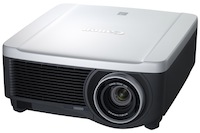
The REALiS SX6000 LCoS multimedia projector offers an SXGA+ resolution and a brightness of 6,000 lumens. |
Canon has unveiled two new high-end models in its REALiS line of LCoS-based multimedia projectors, along with four sub-$800 portable LCD projectors.
The new LCoS models--the SX6000 and the WX6000--are installation projectors designed for large venues. The SX6000 provides a brightness of 6,000 lumens and a resolution of 1,400 x 1,050 (SXGA+). The WX6000 offers a brightness of 5,700 lumens and a resolution of 1,440 x 900 (WXGA+). Both offer a contrast ratio of 1,000:1.
Features of both projectors include:
- LAN network connectivity;
- Choice of three interchangeable Canon lenses (1.5x standard zoom, a 0.8x ultra wide-angle fixed lens, and a 1.7x long-focus zoom);
- Optional DICOM simulation mode;
- Canon's Aspectual Illumination System (AISYS) optical technology;
- Six-axis color-correction and 3D LUT.
Inputs and outputs include HDMI, DVI, RGB (mini D-sub 15-pin), RJ-45, and RS-232C. (Complete specs have not yet been released.)
The Canon REALiS SX6000 and REALiS WX6000 are expected to ship by October 2012. The SX6000 is expected to be available for $6,799, while the WX6000 will run $4,999.
Canon has also debuted four new portable LCD projectors, the LV-8227A, LV-7392A, LV-7297M, and LV-7292M, all of which are expected to be available for $799 or less.
The LV-8227A offers a brightness of 2,500 lumens, a resolution of 1,200 x 800 (WXGA), and a contrast ratio of 3,000:1.
The three other models are XGA-resolution projectors (1,024 x 768). The LV-7392A offers a contrast ratio of 2,000:1 and a brightness of 3,000 lumens; the LV-7297M provides light output of 2,600 lumens; and the LV-7292M offers a brightness of 2,200 lumens.
Other features include:
- 1.2x optical zoom;
- Special image modes for different lighting and surface conditions, including a mode for projecting on blackboards and greenboards;
- Automatic setup; and
- Up to 6,000 hours of lamp life in economy mode (5,000 hours for the LV-7490).
The LV-8227A ($799), LV-7392A ($799), LV-7297M ($699), and LV-7292M ($599) are expected to ship later this month.
Additional details about all the new projectors can be found on Canon's site.