Bretford's New High-Back Sofa Provides Privacy for Casual Learning
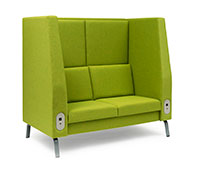

Bretford's Motiv High Back Sofa features high walls for privacy and sound obstruction.


Bretford Manufacturing has unveiled the new Motiv High Back Sofa, designed for comfort, privacy, and power support in casual learning environments. An optional power module includes an AC outlet as well as USB charging, to power up laptops, tablets, and other mobile devices. The sofa's high walls and back provide both privacy and sound obstruction.

All Motiv soft seating products, which include modular and freestanding sofas, chairs, and benches, can be upholstered in a wide variety of fabrics and leathers and are available with optional power.

For more information, go to the Bretford Web site.

About the Author

Rhea Kelly is editor in chief for Campus Technology, THE Journal, and Spaces4Learning. She can be reached at [email protected].

Featured

  • large group of college students sitting on an academic quad

    Student Readiness: Learning to Learn

    Melissa Loble, Instructure's chief academic officer, recommends a focus on 'readiness' as a broader concept as we try to understand how to build meaningful education experiences that can form a bridge from the university to the workplace. Here, we ask Loble what readiness is and how to offer students the ability to 'learn to learn'.

  • Graphic of connected devices protected by digital padlocks

    Veeam Launches Agent Commander to Help Detect Enterprise AI Risk

    Veeam Software has introduced Agent Commander, a new platform designed to help enterprises detect AI risk, protect AI systems, and undo AI mistakes.

  • abstract coding

    Anthropic's New AI Model Targets Coding, Enterprise Work

    Anthropic has released Claude Opus 4.6, introducing a million-token context window and automated agent coordination features as the AI company seeks to expand beyond software development into broader enterprise applications.

  • globe surrounded by network connections

    AI Adoption Is Surging, but Infrastructure and Language Gaps Persist

    Artificial intelligence may be spreading faster than previous waves of consumer tech, but a report from Microsoft's AI Economy Institute suggests its benefits are concentrating in a relatively small set of countries, with infrastructure and language emerging as major dividing lines.