Report: Generative AI Taking Over SD-WAN Management
In a few years, nearly three quarters of network operators will use generative AI for SD-WAN management, according to a new report from research firm Gartner.
That is a strategic planning assumption backing Gartner's latest report on software-defined, wide-area networking, titled "Magic Quadrant for SD-WAN," published this week with extensive examinations of 11 vendors.
Specifically, the assumption is that: "By 2027, 70% of network operations personnel will rely on generative AI for Day 2 SD-WAN management, up from less than 5% in early 2024."
That assumption sets the tone for the report, which divides covered venders into four sections titled Leaders, Challengers, Visionaries, and Niche Players. "A Leader has demonstrated a sustained ability to address changing end-user requirements in the SD-WAN market as well as long-term viability. A Leader can drive, shape and transform the market in areas such as AI networking or security as well as maintain strong relationships with its channels and customers," the report explained. Most of the 11 vendors' offerings use AI in one form or another.
In fact, "AI/GenAI networking support for configuration management, incident management, and documentation access" is one of the common features of the SD-WAN market, which wasn't even a thing a few years ago. What's more, the firm now lists AI networking as a major factor in differentiating between vendors.
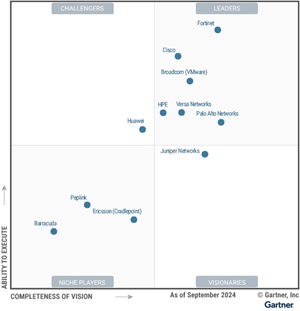 [Click on image for larger view.] Magic Quadrant for SD-WAN 2024 (source: Gartner).
Here's what Gartner said about AI at Fortinet, the leader on quadrant's "Ability to Execute" axis: "Over the next 18 months, we expect the vendor will invest in digital experience monitoring (DEM) for deeper end-user experience and application performance visibility, machine learning with adaptive network performance thresholds, and its generative AI (GenAI) assistant."
Similar comments were made about other vendors, a sampling including:
- Cisco: "Over the next 18 months, we expect Cisco will invest in its AI assistant, integrate its SD-WAN offerings with Cisco XDR and deliver distributed security policy enforcement, regardless of the appliance deployed." What's more, "Cisco's SD-WAN product roadmap is aligned with end-user organization needs, focusing on its AI assistant as well as security and networking integration."
- Huawei: "Over the next 18 months, we expect Huawei will invest in its AI assistant, multiservice converged customer premises equipment (CPE) for 5G and Wi-Fi 7, and optimization for asymmetrical deployments with CPE on only one side of the connection."
- Versa Networks: "Over the next 18 months, we expect the vendor will invest in multicloud connectivity, Versa AIEdge to support local GenAI inference models, and sovereign SASE to enhance its visibility and observability analytics and deliver its self-protecting network built on VersaAI." Furthermore, in discussing product strategy, Gartner said: "Compared with other vendors in this research, Versa Networks has an above-average SD-WAN product strategy with a focus on multicloud connectivity and AI networking that is aligned with current and future end-user needs."
- Juniper: "Juniper Networks' recent and planned innovations in AI networking have started to change SD-WAN buyer behavior."
Gartner also explained just how much impact AI networking is having:
AI and more specifically, GenAI, is increasingly being included in SD-WAN operational capabilities across Day 0, Day 1 and Day 2 life cycle management. We also see AI assistants to help simplify interaction with the network and provide a more dynamic management environment. The objective is to reduce operating expenditures (opex), increase speed/agility and improve uptime/end-user performance. This may result in accelerated time from design to configuration, less trouble tickets, less time to resolve trouble tickets, etc. Although it is still early in many vendors' product development, we are seeing this functionality incorporated into an increasing number of vendor solutions offering differentiation. We expect these capabilities to improve over the next 18 months. The longer-term challenge will be defining the business case and ensuring customer trust in using such solutions.
Market recommendations for infrastructure and operations (I&O) leaders responsible for building and managing WANs include:
- Build a WAN architecture that aligns with end users, branches and applications. This may mean a hybrid WAN with MPLS and internet, or internet only with dual internet. The architecture choice depends on how many on-premises workloads versus cloud workloads exist, the types of applications, the number of users at a site and the locations of end users.
- Determine — especially if you're a cloud-first organization that heavily uses public cloud and SaaS services — the SD-WAN offering suitability by validating depth and/or breadth of cloud provider and cloud onramp integrations.
- Lean toward SD-WAN/SSE combinations with deep explicit integration when implementing a dual-vendor SASE architecture by performing a POC and focusing on the GUI integration as well as automatic traffic redirection.
- Evaluate SD-WAN vendors by analyzing network automation and AI networking capabilities as a core requirement to improve support efficiency if your organization is operationally focused.
- Choose SD-WAN vendors to optimize application performance by evaluating performance optimization capabilities for real-time and non-real-time traffic and SaaS optimization for applications in the cloud.
- Focus on lightweight SD-WAN solutions when there are distributed hybrid work users and applications primarily in the cloud.
- Quantify the total cost of hardware, software and maintenance for an SD-WAN deployment. SD-WAN solutions more commonly have opex-friendly business models, with a strong shift from upfront capex to annual license subscriptions. To perform a proper evaluation and comparison, quotes should include all platform, license and support costs over a three-year baseline.
- Prefer SD-branch solutions to simplify the management of LAN, WLAN, SD-WAN and security for small branch offices.