Best Practices for Designing Higher-Ed AV Environments

Sennheiser’s EW-DX Wireless Handheld Microphone
As campuses invest in flexible, multi-use learning environments, AV infrastructure is increasingly incorporated into the design phase rather than invested in post build. However, specifying the right hardware is only part of the equation. Campus Facilities and AV directors are discovering that long-term performance depends on how well those systems can be monitored, managed, and maintained at scale.
The shift is significant. Five years ago, many institutions treated AV as furniture, something ordered after the walls went up. Today, audio and video systems are being mapped alongside HVAC, lighting, and network infrastructure during the architectural planning stage. That earlier seat at the table gives AV and IT professionals the opportunity to address acoustics, sight lines, cable pathways, and network capacity before construction begins, avoiding costly retrofits and ensuring that every room is built to support the learning experiences it will host.
But design-phase inclusion raises its own challenge, chiefly a question of scale. Planning AV deployments for dozens or even hundreds of rooms consistently without ballooning timelines and budgets is complex and full of potential points of failure. This is where cloud-based planning and configuration tools have become essential. Browser-based room planners allow AV teams to map layouts, model microphone coverage zones, and identify optimal placement for ceiling arrays and loudspeakers before a single device ships. Templates and presets make it possible to replicate a proven design across an entire building or campus, reducing the guesswork that once accompanied each new space. The result is faster commissioning, fewer on-site surprises, and a more standardized baseline of quality from room to room.
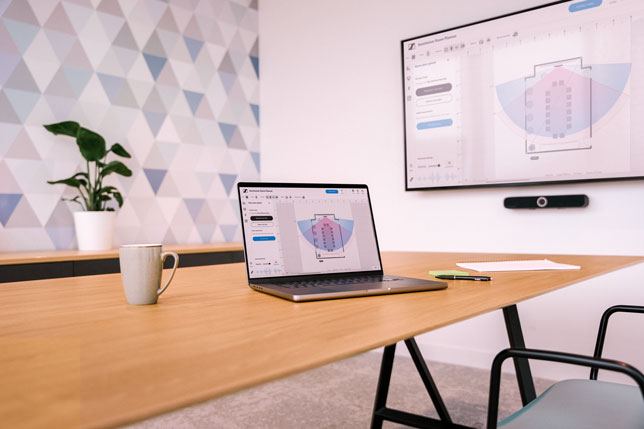
Plan the perfect space with Sennheiser Room Planner
Acoustic treatment deserves equal attention at this stage. Hard, reflective surfaces—glass walls, polished concrete, whiteboard arrays—are common in modern campus architecture, but they create reverberation that erodes speech intelligibility. Carpets, curtains, ceiling baffles, and acoustic panels should be specified alongside the AV hardware, not added as afterthoughts. When a room's acoustics are managed, the technology in it performs dramatically better, and voice lift or sound reinforcement demands are reduced.
Wireless spectrum planning is another area where upfront design work pays long-term dividends. Campuses are dense wireless environments with Wi-Fi access points, Bluetooth devices, wireless microphones, and IoT sensors all competing for spectrum. Without deliberate frequency coordination, interference can cause dropouts in wireless microphone systems or degrade the performance of Wi-Fi-dependent tools like mobile assistive listening apps. A thorough RF survey during the design phase, combined with choosing microphone systems that operate on dedicated, interference-free frequency bands, helps institutions avoid the frustrating and difficult-to-diagnose audio problems that often surface only after a room is in daily use.
With planning complete, the focus turns to deployment, and this is where interoperability becomes the deciding factor. In higher education, the challenge is not only selecting the right AV hardware but ensuring it also integrates into existing platforms and can be managed consistently at scale. Sennheiser microphones address this by combining open APIs for customized integrations with ready-made modules and plugins for systems such as Q-SYS, Crestron, and Extron, providing both flexibility in system design and a more streamlined path to configuration and commissioning. Certifications for platforms including Microsoft Teams and Zoom provide added confidence in day-to-day use, while integrations with camera manufacturers such as AVer, Datavideo, and Lumens are among those enabling camera tracking based on voice activity, supporting more natural hybrid learning experiences. Together, this supports more standardized, repeatable deployments across campus environments. Looking ahead, closer collaboration across manufacturers is set to further align devices within integrated design environments, reducing friction in configuration and creating more intuitive AV experiences.
For technical staff, scalability is the parallel concern. A solution that works beautifully in one room but requires bespoke programming for every subsequent deployment is not practical for a campus-wide rollout. The most effective AV strategies rely on repeatable room types—standardized hardware packages and control templates that can be cloned and adjusted rather than rebuilt from scratch. When paired with centralized monitoring, this approach lets a lean team support a large and growing inventory of spaces without proportionally increasing headcount.
Once rooms are commissioned and in daily use, the operational question shifts from deployment to management. Higher education campuses may have hundreds of AV-enabled spaces spread across multiple buildings, each with a mix of microphones, cameras, control processors, displays, and collaboration platforms. Keeping that ecosystem healthy with a small technical team requires centralized, remote-capable management software. Cloud-based device management platforms like Sennheiser's DeviceHub allow AV and IT staff to monitor device status, push firmware updates, adjust settings, and troubleshoot issues from a single dashboard without dispatching a technician to each room. Alerts can flag problems before a faculty member discovers them mid-lecture, and usage analytics can reveal which rooms are underutilized or consistently experiencing issues. This kind of proactive maintenance transforms AV support from reactive ticket resolution into a managed service model, freeing staff to focus on strategic improvements rather than daily firefighting.
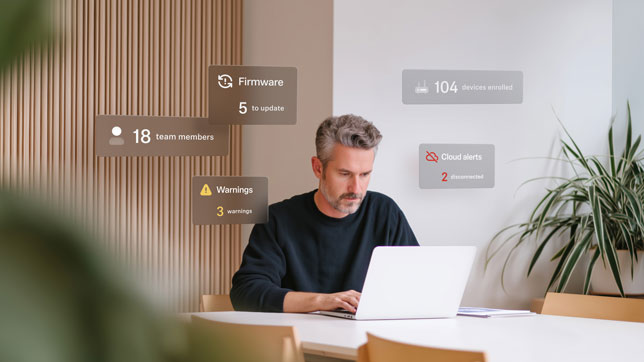
Sennheiser's DeviceHub for cloud-based device management platform
A key thing to keep in mind is that none of this extremely hard work and meticulous planning will matter if the people in the room cannot use the technology easily. Faculty adoption hinges on simple, intuitive user interfaces. If an instructor cannot start a class within 30 seconds of walking into the room, the system has failed its primary user. Ceiling-mounted beamforming microphones contribute to this simplicity by removing the need for handheld or body-worn devices and automatically tracking the active speaker. Combined with intuitive touch-panel control, ideally a single button to launch a session, the technology recedes into the background, becoming a fundamental feature of instruction during a lecture or discussion, rather than an obstacle.
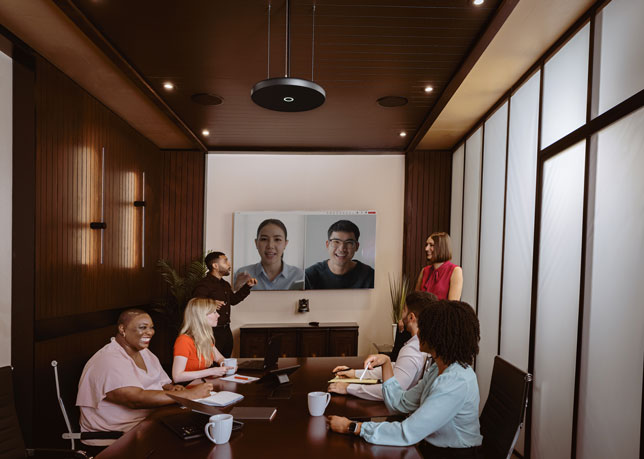
TeamConnect Ceiling Medium for Classrooms and Meeting Spaces
The institutions achieving the best outcomes are the ones treating AV not as a one-time purchase but as a managed ecosystem. Upfront investment in acoustic design, cloud-based planning, interoperable hardware, and centralized management creates a foundation that adapts as pedagogical approaches evolve whether that means reconfiguring a lecture hall for active learning, adding voice lift for a newly renovated auditorium, or scaling hybrid capabilities to a satellite campus. When the infrastructure is designed with operational longevity in mind, the technology stays out of the way, and the focus stays where it should be: on teaching and learning.