Collaboration

Real-Life Teaching in a Virtual World

Few technologies have been subject to more hype and subsequent disappointment than Second Life. Corporations from shoe manufactures to cruise lines to news services set up shop with hopes this new frontier would bring soaring profits. Most evacuated shortly thereafter when the effort resulted in spaces devoid of audiences and buyers. A notable exception, though, is education.

Education is thriving in Second Life. This enthusiastic subculture is abuzz within the Second Life realm, constantly interacting inside and outside Second Life. Educators are exploring every possible tool the 3D virtual world offers and establishing best practices along the way.

Linden Lab, the creator of Second Life, reports on the company's Web site that universities such as Harvard, Texas State, and Stanford have Second Life campuses. While Linden Lab states that more than 200 educators and about as many universities are using Second Life, all signs point to a far larger community.

The Second Life Educators (SLED) community is an e-mail list that includes more than 4,700 working in or interested in education in Second Life. SLED was created in October 2005 to help newcomers adjust to Second Life, exchange resources, network, collaborate on projects, and share best practices.

Real Life Education in Second Life is a group inside the 3D realm that boasts 3,500 members. It is for sharing information, asking questions, and getting notices of in-world and "real life" events.

CC International is a group of 4,200 that promotes the use of virtual reality for education. The goal is to provide training seminars and certificates in building, scripting, furniture making, and more, offering college-level classes for credit, possibly toward a degree.

Thousands are involved in these three groups alone. There are many more groups, some of which focus on fields of study, such as architecture, music, and business.

How Educators Use Second Life
Some universities and colleges use the tools provided in Second Life to build exact replicas of their campuses. The virtual recreations can be used as recruiting tools to reach students and teachers and to showcase the institutions to other important audiences, such as donors.
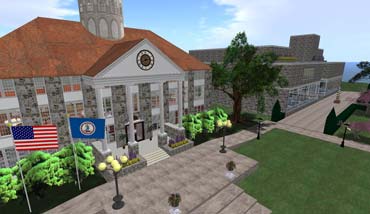

James Madison University's Second Life working campus

The more active educational uses of Second Life take advantage of the immersive experience. Some faculty teach classes within Second Life, and others use Second Life as a supplement to traditional classroom environments and for enriching an existing curriculum. Educators say the immersion facilitates experiential learning, simulation, roleplay, collaboration, co-creation, experimentation with new ideas, and learning from teachers and from each other. One professor even teaches education students how to use Second Life in their lesson planning.

"My job is to look at emerging technologies and see how they can be used," said Sandra Sutton Andrews, an educational researcher at Arizona State University College of Education. "Good use of technology is not using bells and whistles for their bells and whistles. Good use of technology has research that backs it up."

Andrews said she takes education students into Second Life to teach them how to use the technology appropriately. She is currently introducing science students to the 3D realm.

"The virtual world gives a greater sense of presence than discussion boards," said Andrews. "The students get a better feel for the teacher, and it is more fun."

And there is another, simpler use for Second Life: office hours. Instructors and their students can communicate in text or by speaking over a microphone in Second Life while at home or in an office, eliminating the need to travel.

(For more uses of Second Life, go to sleducation.wikispaces.com/educationaluses.)

The Appeal
The immersive environment is unlike any other teaching venue. Astronomy can be taught using virtual planetariums with stars you can click on to learn their temperatures. Literature can be taught within buildings designed to replicate structures described in a novel, and in the era they existed. Chemistry students can walk inside a molecule. Even emergency responders learn by 3D simulations complete with timed events to which they must react.
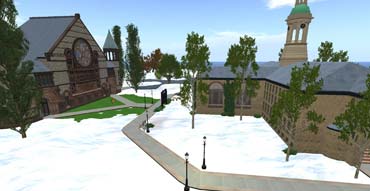

Virtual Princeton

Real-time meetings and collaboration, in contrast to Web pages, are far more engaging. A 3D virtual environment is believed to increase participation and improve retention. It also allows students to meet and learn from each other no matter their geographical location.

The fun factor can't be ignored, either. While some people think Second Life is too much fun for a serious endeavor, many teachers will retort that learning should be fun. A learning environment such as Second Life can make students eager to join the classes or projects.

Another significant benefit to using Second Life is the availability of multimedia presentation tools. An instructor can load a PowerPoint presentation onto a virtual screen, play a video on a virtual monitor, and type Web site URLs students can launch immediately within the program. Teachers hand out class notes or other literature on note cards that can be copied into Word documents, and can make graphics that are clickable to reveal more information.

Finally, you can't beat the price. Second Life is free to join, so both teachers and students pay nothing to get started. Virtual land--the meeting space--has a fee, but Linden Lab gives a discount to educational institution.s (See secondlife.com/land/privatepricing.php).

In further cost savings, instructors can load a PowerPoint presentation or a video without investing in expensive projectors or screens. This can mean a huge financial savings--less wear and tear on hardware and in some cases, even elimination of the equipment.

Getting Started
It's important to note that Second Life requires a computer with hefty specs to run properly, which could be a barrier to entry for some. Fortunately, computers sold today are adequate.

In the coming weeks, we will delve in to take a look at specific ways universities and colleges are using Second Life.

Meanwhile, you can check it out at secondlife.com.

About the Author

Denise Harrison is a freelance writer and editor specializing in technology, specifically in audiovisual and presentation. She also works as a consultant for Second Life projects and is involved with nonprofits and education within the 3D realm. She can be reached here.

Comments

Tue, Jul 20, 2010 kelly

do any of know any virtual world games that are fun and dont reqire download except habbo cause its boring if you do just post something now thank you so much

Sun, Jun 28, 2009 jhgykjihgyuhfhg ireland

i want to join

Wed, Mar 4, 2009 Cathy

In my opinion corporate was crazy to pull out of SL ... they will be wanting to get back in within a year or two and may end paying a premium. I was on Dells site a couple of days ago and the site is fantastic full of education potential for computer users, sales, etc,. and it is nothing but an empty shell...Dell is really missing the boat on this one.

Mon, Mar 2, 2009 Janet Loo

I would suggest looking at the Immersive Education Initiative for educator/teacher support and tools related to using immersive learning technology such as Second Life, Wonderland, Cobalt, and various learning games and simulators. It's the place everyone is going to get started, and for assistance, and it's free. Best practices and free training too. How great is that! I found them through my local college tech program, and then again on a google search, but here's the direct link: http://ImmersiveEducation.org/ and here's some text copied from their home page, too: _____ The Immersive Education Initiative The Immersive Education Initiative is an international collaboration of universities, colleges, research institutes, consortia and companies that are working together to define and develop open standards, best practices, platforms, and communities of support for virtual reality and game-based learning and training systems. Hundreds of faculty, researchers, staff, administrators and students are members of the Immersive Education Initiative, which is growing at the rate of approximately 2 new members every day. Initiative members have early access to the Education Grid, where they can conduct classes and meetings within a growing collection of virtual worlds. Initiative members can also use the Education Grid to build custom virtual learning worlds, simulations, and learning games. Immersive Education and the Media Grid were recently recognized with a prestigious national award by Computerworld for being “innovative, promising technologies which hold the potential to significantly affect society in the near future”. The Immersive Education Initiative is a merit-based, not-for-profit initiative of the Media Grid international standards group. Membership is free (no fee) and open to the public but restricted to organizations and individuals that have experience using virtual worlds, simulations, or game-based learning technologies. ____ I just joined and am already getting invitations for free training on Wonderland, Alice, and more great immersive learning tools. Janet

Fri, Feb 27, 2009 Cecil Borg Prime

Howdy, I'm Cecil Hirvi The Good Griefer. I bring creativity to SL by pushing the envelope and people's buttons because creativity is subversive and necessary to stimulate originality. Want to see what I mean? Check this out: http://www.youtube.com/profile?user=CecilHirvi&view=videos&sort=v Kick out all the naysayers and narrow-minded and SL will be a better place.

Wed, Feb 25, 2009 cogman62 NC

SL is a colossal WASTE of time and resources. Enough said.

Tue, Feb 24, 2009 Denise

Dan and Gina -- What I heard during my interviews for this article support what you say -- a benefit of Second Life in education is that the students tend to stay around. continuing to work together well after the class or meeting is concluded. This is of huge value to those instructors who believe lingering participation is highly desirable, yet usually hard to achieve, in maximizing the curriculum. Leslie: I'd love to see the peer-reviewed articles. Chris: I'd love to see what you are doing there. Docent: I think some nonprofits are still stumbling a bit on how to make SL work, but thanks to the affordable space, they have time to figure it out! Thanks for reading all. I'm very interested in your comments, too!

Sun, Feb 22, 2009 Gina Schreck Colorado

We have been using Second Life for teaching in corporate setting now for over a year and what is fascinating is how much it adds to the "informal learning" opportunities. Students will hang around after a lecture or class to discuss its application and continue chatting, networking and sharing more knowledge--when was the last time you saw anyone do that on a conference call or webinar! Those who complain about the griefers or creepers should know that those freaks are in Real life too! Start hanging out in better places and you will learn and share so much more.

Sat, Feb 21, 2009 Docent Alturas Second Life

I have been in SL for more than two years, and contrary to the "nameless" comments above, I find it much improved. So much so, that although the corporate merchants have mostly left, educators and non-profits have not. The addition of in-world web browsing, YouTube and QuickTime viewers, voice chat, "PowerPoint" presentations, Virtual Reality rooms, holodecks, stunning graphics, and a more robust user client, gives educators the tools that do help motivate students (of all ages) to learn. Non-profits continue to enter SL with more than 70 international NP's currently on a cluster of 4 islands coordinated by Tech Soup International. Any Friday morning you will find 50+ NP Executive Directors and volunteers meeting in SL on the Plush NonProfit Commons island to discuss Real World partnerships, fund raising, governance, grant writing, and mentoring. Like Twitter, Facebook, MySpace and other social networks, Second Life is another thread in the tapestry of emerging technologies available to help us inspire our students and enjoy learning with them.

Fri, Feb 20, 2009 Dan

As the founder of an online education software company, I have seen increased student participation with 3D environments. Virtual experiences like SL can be excellent ways to provide “authentic” learning, especially when coupled with real world problems. For example, a passenger boarding simulation can be used to teach basic probability theory (e.g. http://www.brainingcamp.com/units/dataAnalysis/problem). When solving problems, students can also use forums like SL to communicate, collaborate, and exchange ideas.

Fri, Feb 20, 2009 Denise

I have to plea ignorant to specifics, but I believe IBM and now Microsoft both were/are building private "layers" of sorts that are more affordable and private to address the problems you mention. The MS effort is very public; I have just been to busy to get educated on it.

Fri, Feb 20, 2009

SL went belly up by 2007 for any serious use: too many griefers and to slow of an updating of the technology. It really hasn't changed significantly since 2005. Only there are many millions of jerks instead of just a few. It's been ripe for a second generation product for a long time, but apparently none is forthcoming.

Thu, Feb 19, 2009 Dalal Shakopee, MN

As the co-owner of a virtual online high school, http://christinainternationalhs.com, I know that SL will work very well with a product we are already using called Education2020. The knowledged and effort put into their product is of the highest standard and provides a quality education platform for students in any state or country. Thanks to them the students at CIHS will have the highest standard of education available to them through us.

Wed, Feb 18, 2009 Denise

It's hard to argue with the ease of presentation tools, isn't it? Working with nonporofits in Second Life means communicating their messages to people who either seek them out or come upon them. Being able to have a video (that costs nothing to project), a PowerPoint presentation shown on a free viewer, posters that when you click go to web pages about the content and the choice of text or voice -- it's quite wonderful. And the immersive environment, I know from a fact from my own nonprofit there, is highly effective. Are there any presentation tools SL does not have that you wish it did?

Wed, Feb 18, 2009 ChrisG Texas

Really interesting input from the group. I would like to offer my own. I lead the Educational Technology team at TSTC and we are extremely active in virtual world education, especially in relation to SL. We have found, through our course offerings, the 3d environment offers opportunities to educators that have never been feasible in prior delivery plaforms (i.e. simulations that are too costly to use, too complicated to implement, or simply too dangerous). We have alleviated many challenges, however I will agree there are still many to overcome. We also need to keep in mind that virtual world education is still a relatively new frontier and there is still alot of room for improvement. This newness is also one of the exciting things that drives our team, understanding that we have the opportunity to be involved with finding solutions to challeneges while establishing the ground work for others to follow. Although we have only been teaching in-world for little more than a year, our early experiences through our vTSTC campus indicate the increase in retention and engagement through immersion outweigh the costs. At least that has been our experience.

Wed, Feb 18, 2009 JudyArx Scribe Long WHite Cloud

I wonder if any of us see a pencil as passe! What excites me most about SL is what will be done with it. Like a beautiful informative drawing I lose the sense of what it is and have my mind stretched by what it suggests. Many instituions and individuals are also not willing to spend time on producing quality images but many seem to love the production of paperwork about the structures and middle management - prehaps we should try to convince others to concentrate on the content again and worry less about pencil. let me sharpen my 6b pencil and extend my draw distance...

Wed, Feb 18, 2009

I'm curious about what is "newfangled" from an educators' perspective if real-time interraction on a global scale is passe. How educators are interracting with a broader audience more effectively? Or is reaching a broader audience interractively what is passe?

Wed, Feb 18, 2009 Leslie Jarmon

There is extensive research being conducted in SL, educational activities are widespread across many disciplines, and institutions are using it for meetings, office hours, lab sections, field trips, modeling, data visualization ... and some for recruitment. We've already published a number of peer reviewed articles about SL and collaboration and pedagogy, as have a growing number of scholars from many disciplinary perspectives and countries. It's use for learning activities and project-based activities with online distance-learning courses and for seniors has just started and will continue to grow.

Wed, Feb 18, 2009

A librarian using Second Life is like a Grand Prix champion driving a Model T. SL was passe a year after it was released and only old timers fascinated by this "newfangled technology" can justify their time wasted on it.

Wed, Feb 18, 2009 Cathy

Like many things it's going to wobble...this economy changes everything it could spell the death knell or it could be the open door for many people to start businesses...time will tell. 2nd LIfe may not be the ultimate end product but I am sure that in 10 years we will see some form of this thriving.

Wed, Feb 18, 2009 Denise

Kenny -- Thanks for the feedback. I agree that SL probably won't be the endpoint. But no one yet has a viable competitor (look at Google's high-profile failure). SL could be its own worst enemy if it doesn't solve the problems mentioned by the second poster here. And to the second poster: I agree that many institutions as a whole aren't as active, but there are many smaller, individual efforts by instructors. I hope you'll be seeing more info about the research on its use soon, too! Thanks for reading!

Wed, Feb 18, 2009 Bladerick Scribe Waterloo, Canada

There seems to be more and more use of virtual worlds in education. SecondLife is not going to be the final frontier... its a stepping stone into a new method of content delivery, and people had better get used to taking part in virtual worlds now. As for research, check out the research by Ken Hudson aka Kenny Hubble at Loyalist College: http://www.slideshare.net/kenny.hubble/applied-learning-in-virtual-worlds-loyalist-college-border-simulation-presentation They have done a study on using SL to train border crossing guards and have encountered a marked improvement in "soft skills" and interview training using an SL location as a simulation.

Wed, Feb 18, 2009

We're seriously still talking about this? Despite your numbers, most institutions have scaled back their use of SL, and with good reason. I would love to see Andrews' research on this. If she has any, it would be the first substantial research I've read on SL. Otherwise, it's all hype. Even if her research shows SL gives students a "presence." The time needed to train, the clunkiness, the distractions, etc. surely outweight the benefits.

Add your Comment

Your Name:(optional)
Your Email:(optional)
Your Location:(optional)
Comment:
Please type the letters/numbers you see above