Research

Survey Reports Many Online Learners Never Seek Help Before Dropping Out

Among online students who dropped out of their degree or certificate programs, 40 percent failed to seek any help or resources before abandoning their programs, according to a recent EducationDynamics survey. Conducted in November 2008 among about 150 respondents who visited EducationDynamics' sites eLearners.com and EarnMyDegree.com, the survey was designed to identify students' motivations for deserting their online degree or certificate programs.

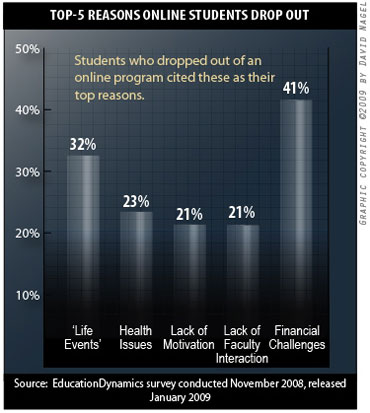
Financial challenges (41 percent) proved to be the main contributor to student attrition, followed by life events (32 percent), health issues (23 percent), lack of personal motivation (21 percent), and lack of faculty interaction (21 percent). Nearly half (47 percent) of students who dropped out did so even before completing one online course.
When asked to select the resources that online institutions could have provided to improve the online student experience, 53 percent craved more online student services and Web-based academic advising. Self-help, time management, and organizational advice also ranked as coveted offerings among students who dropped out (46 percent).

"These survey results confirm the fact that schools can play a more active role in retaining students by identifying their key life issues, such as important personal events and financial issues, and creating compelling interactive content that addresses them," said Peter Tomassi, senior vice president of product development for the company.

The survey also captured the school-student communication methods students prefer, and new media avenues proved to be the most popular among respondents. Ninety percent of students preferred connecting with others online through discussion forums and social networking communities. "While students tend to drop out prior to utilizing retention resources, we believe they are generally interested in such assistance so long as services are available in convenient, easily accessible formats," Tomassi said.

Of students who dropped out, the company reported, 71 percent plan to resume their online education within the next two years; 7 percent intend to enroll in a campus-based program; and 21 percent have no specific plans.

About the Author

Dian Schaffhauser is a writer who covers technology and business. Send your higher education technology news to her at dian@dischaffhauser.com.

Comments

Wed, Feb 4, 2009 Kelley Norris Oklahoma City, OK

As an online coordinator for three years at a smaller private university, I whole-heartedly disagree with the idea that online students are lazy, etc. Many have had life circumstances that precluded their educational goals. I daresay that these same reasons could be applicable to any traditional student population. I will say from my perspective that instructor interaction plays a significant role in in the satisfaction level of our students.

Mon, Jan 26, 2009

People who sign up for online degree programs are people who have neglected themselves for a long time. They have not held themselves to any kind of a standard. They have been lazy, short-sighted, and/or too distracted by the present to think about the future. Many of them sign up because they think it will be "easy," so they quit at the first sign of work or stepping outside of their tight, little comfort zones. They've been spoiled by a society that makes excuses for anyone who claims a "learning disability" or some kind of "family issues." They are people who have never done anything difficult, and they are raising their children to shy away from work and responsibility. They don't ask for help before quitting because they don't want anyone to ask them to account for their sluggish, selfish, myopic decision-making skills.

Wed, Jan 14, 2009 Jane Anderson Northland Community College

I've taken several graduate-level online courses and I can tell you that the teacher's interaction is essential. The best courses I've taken included rigorous curricula and plenty of interaction among the students, as well as commentary from the instructor. The worst courses I've taken seemed to be set up at the beginning of the semester and put on autopilot. The instructor's comments were few and far between, contained terrible spelling errors and/or typos and contained little substance. There's nothing worse than getting back an assignment with the feedback being "Good job" and nothing else. Also, I don't think students are aware if there are any resources available for assistance. Perhaps online offerings could have a section listing those ideas and resources.

Wed, Jan 14, 2009 Thomas Lipscomb University of Southern Mississppi

It is clear from the emergent literature that an important factor is "transactional distance" - defined as the degree of "connectedness" the student feels with classmates and the instructor. (Just had a Ph.D. student finish up an interesting dissertation related to this. Hope to get it ready for publication soon). I find real-time audio discussions helpful in this and in fostering better communication - it just makes the whole thing seem more personal and the students like it. We also have to be realistic and realize that students often self-select for online classes for a variety of reasons - sometimes distance, sometimes other things. I would speculate that many are time pressured (like most of us!) while some may lack high levels of motivation, etc. These kind of issues surely would contribute to dropping the course or degree plan and may not be related to modality of instruction per se. I find there is greater variability in final grades for the online section as compared to the face-to-face but overall there is no statistically significant difference. Maybe I should try to publish that.... TJL

Wed, Jan 14, 2009 Mark Winegar Mount Marty College

I note faculty can only impact 2 of the 5 top reasons for attrition; interaction and motivation. While there are many factors to motivation instructors are in direct control of their interaction with students or the lack of it. Furthermore, faculty-student interaction is a key factor of motivation. Perhaps students would be better served by limiting enrollments and maximizing the opportunities for student-faculty interaction.

Wed, Jan 14, 2009 John Hamer Twin Cities, MN

Your graph adds up to way more than 100%. I assume that maybe students checked more than one reason. I think a big factor in on line instruction is the instructors comfort level with the platform and also with the instructors comfort with electronic education in general.

Wed, Jan 14, 2009 Lynn Hunter MassBay Community College

Faculty interaction is so important, whether in traditional or online education. Glad this study included it. For a dissertation study on how adult women online learners with families manage their studies, see: http://etda.libraries.psu.edu/theses/approved/WorldWideIndex/ETD-1770/index.html

Mon, Jan 12, 2009 Julie Owen

This article is yet another example of why students should be assessed prior to entering an online program. Determining a student's strengths and weaknesses and how they relate to distance learning gives valued insight to the administrator of what areas the student needs assistance. Using a tool like READI - Readiness for Education At a Distance Indicator (readi.info), is a great beginning step in an online orientation. In addition, READI would fill the void of "53 percent of students who crave more online student services".

Sat, Jan 10, 2009 Prof. Ann L NYC

For faculty teachingt in the online programs, I would be curious to know how many faculty engage in significant one-on-one dialogue with students during the term, or if it is more 'whole group.' Any faculty out there care to comment? The one-on-one may make a difference in attrition, I would hazard a guess. Thanks!

Fri, Jan 9, 2009 Bob Knipe Genesee Community College

Very interesting... thanks! This corroborates some research by DL-non-persisters some years ago by Monroe Community College, but with a few differences. Of the students you surveyed, what percent were community college, upper division, graduate?

Add your Comment

Your Name:(optional)
Your Email:(optional)
Your Location:(optional)
Comment:
Please type the letters/numbers you see above