Modesto JC Overhauls '50s-Era Facilities for State-of-the-Art Audiovisual Production
In order to accommodate new state of the art equipment for its audiovisual programs, California's Modesto Junior College (MJC) was looking not just at rewiring a building, but bringing 1950s-era building construction up to 2009 standards--a huge undertaking by any measure.
The college offers AA degrees in radio production and TV production, as well as certificate programs in both areas. It's also currently developing a certificate program for audio recording technology. So building renovations and additions also needed to accommodate equipment that hadn't been conceived when its facilities for Arts, Humanities & Communications division were built, let alone taken into account in the construction.
"Our goal was to bring the studio spaces and technology up to current industry standards so that students would have the opportunity to work with equipment and software they would encounter the first day on a job," said Michael Sundquist, dean of MJC's Arts, Humanities & Communications division.
The results: an 820-seat proscenium theatre; a 74-seat proscenium theatre; an 1,800-square-foot television studio; a 1,500-square-foot rehearsal studio; two radio production and on-air studios; and an audio recording studio.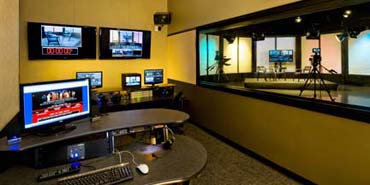
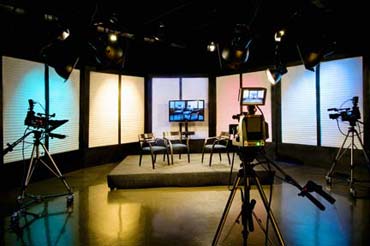
"All studios incorporated new equipment," said Sundquist. They selected Audio Arts sound boards in the radio studio, Final Cut Studio 2 for video production on a combination of iMacs and Mac Pros, and Logic Studio software with a Digidesign control surface for the recording studio. The TV studio uses a Broadcast Pix switcher and three JVC HD cameras.
The studios are used as hands-on labs, but they also serve other school activities. "All studios are connected to both theatre spaces in order to provide the capability of recording live events," he said. "The theatre, music, and TV programs recently collaborated on the taping of live performances of a Broadway-style musical."
AVI-SPL, the company that installed the audiovisual equipment, said the TV studio includes four small connected edit suites, a control room with a separate audio booth, a voice-over studio, a green room, and the central rack room. The studio itself, in addition to being a three-camera HD studio, serves as a classroom. The classroom is capable of displaying several formats of tape/disc/digital storage on a 52-inch cart mounted plasma or through an SDI connection to the routing switcher. It can display video from the production switcher or from any of the edit suites. When the classroom is not in use, the monitor can have any camera or program/preview signal routed to it, so it can be used as a talent monitor. Audio into the studio space is routed via the same routing switcher to Mackie speakers hung from the lighting grid.
The TV studio has the ability via two very large interconnection panels to send or receive many formats of audio or video signals. In fact, the TV studio or the rehearsal hall can be used as auxiliary spaces for the recording studio control room. The rehearsal hall can be used as a second TV studio as well, since additional camera cables terminate in that space as well as the main theater and the little theater.
Dan Koepke, served as project manager and project engineer, subcontracted for AVI-SPL through Media Support Associates. "Connectivity and flexibility are really the hallmarks of this project, he said. "Throughout, there is an ability to cross connect and repurpose rooms as needed. Clear-Com headset stations connect all facilities in the building to allow behind-the-scenes production communication, too."
Koepke said the radio studios' "Air" and "Production" are based around Audio Arts/Wheatstone D75 consoles that are capable of handling digital and analog sources. Each console is supplemented with two half-height equipment racks with all the normal CD recorders/players, cassette decks, a turntable, and the digital source devices like Macs and Windows-based PCs. Each studio is capable of taking a feed from the other, and, further, each is also capable of talking the roll of the "Air" studio in case maintenance is required in the regular Air studio.
"In fact," said Koepke, "provisions have been added to allow an automated program stream to be patched to the audio processor (last link before air), so both studios could be down, and MJC Pirate Radio would still be broadcasting."
Koepke said the recording studio control room with its Pro Tools environment uses a C32 console and the Pro Tools HD system hardware and software built into the Mac Pro. There are sound sculpting devices in the control room ranging from digital Pro Tools plugins and other software to dedicated, tube-based microphone pre-amps to add warmth to the sound of the mics. There is a separate FX rack with some of the instructors' favorite "blast from the past" effects from DBX, Hafler, and others, as well as a CD recorder, cassette recorder amps, and interface devices to support the operation.
"The recording studio control room is also connected to the actual recording studio," said Koepke, "plus both radio studios so they can be used as 'Iso' rooms during times when the radio studios are not staffed."
MJC's Sundquist said the most important benefit is the ability to offer students the chance to use labs that will closely mirror what they will encounter in the work place. "In some cases, our facilities exceed what they will use when they transfer to a four-year university," said Sundquist.
He said students' reactions have been very positive and that the students are impressed by the installation and functionality of the studios, "especially the students who worked in the 1958 facility."
The challenge now is to stay current as technologies advance. "Our focus will shift to seeking out funding opportunities that will support our equipment repair and replacements needs," he said. "The current economic climate will make this work perhaps even more challenging than planning and building the facilities."