Natural Language is Still Our Most Important Technology
Human language is the most complicated code, by far, that humans use. Math, programming languages, Newtonian physics, chemistry and biology diagrams, all the codes developed by humans over the centuries since we started using language, are relatively easy and limited compared to natural human language. All success in life, no matter what endeavor, depends on using natural language. In the Web 2 world, writing has taken on heightened importance as work teams disperse and Internet communications becomes the lingua franca. You write well or you sink. Why does higher education talk of STEM as if those four disciplines--science, technology, engineering, and math--are the only important disciplines and as if our country will prosper if we just spend enough money on STEM? We are forgetting our most important technical achievement, natural language.
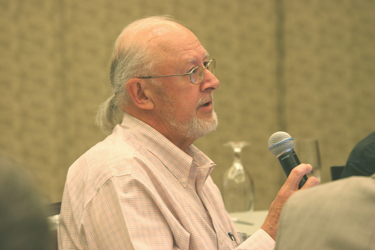
I run a virtual organization, AAEEBL. Eighty percent of my time is spent writing e-mail. The rest is spent talking on the phone or through Skype, updating our Web site, producing documents, or writing for Campus Technology's Web 2.0 newsletter. I follow up almost all personal meetings in person or on the phone with e-mail. Without decent writing skills, I could not have started the organization.
But writing is not about knowing correct grammar--you can be a fluent programmer, for example, and produce lousy applications just as you can have perfect grammar and produce drivel. Writing is all about thinking. In studies from the 1970s, novice writers (i.e., first-year students in college), given a writing task, would immediately start producing text and oftentimes conclude their essay with a paragraph that should have been at the beginning.
Why?
Because, just by writing, they developed their ideas about the topic and by the end of the essay had a clearer idea of what they wanted to say to begin with.
Expert writers, in contrast, take time to think about the topic and plan what they would say. Novices took zero percent of the allotted to plan while experts took up to eighty percent of the allotted time to plan.
What did the experts think about? Most likely: What am I trying to accomplish with this writing? To whom am I writing? What language (tone) is appropriate to this audience? Am I trying to enlarge the idea space or just communicate so all can understand? How do I want to represent myself? What will the reader need to know? Is there a political aspect to this writing? Who might see this writing beyond the intended audience?
This series of mental questions is an example of the heuristic algorithm that expert writers use to plan their writing. This allows them to put their best summative paragraph up front, as well as succeed at the general task.
But we all know by now, after 25 years of the Internet, that the essay model you undoubtedly had in mind as you read what I just wrote is to a large extent an anachronism is this age. In the fifty or so e-mails I write every day, I have to collapse that heuristic algorithm into a few seconds. My essay-writing skills from college have only ancillary value in guiding how I write the e-mails.
It's even more complicated than just having new writing environments (rhetorical spaces) in the Web 2 World. Human natural languages evolve. They are organic and, like living skin, slough off words and meanings constantly and grow new ones. They are moving targets: If your idea of good writing is correctness, then you have a real problem because what was correct at 9:00am has become altered by 1:00pm. What's more, evolution of our natural languages is speeding up because of the flood of writing occurring every day.
It should be clear to all that underlying all human thought is natural language. Humans judge each other almost instantly by speech patterns. We judge communications in writing almost as quickly. You could have a great new idea worth millions but if you can't talk or write about it, society will have lost your innovation.
Yet, despite our natural language being the ultimate technology that humans have ever invented, on any campus it is most likely that those who teach rhetoric and composition--those who run the writing centers or writing-across-the-curriculum programs--will be on average the lowest paid faculty or professional staff. The over-emphasis on STEM disciplines, as valuable as they are to our country, means we are ignoring the most important skills students need to acquire. Keep the emphasis on STEM, but make it STEML--science, technology, engineering, math, and language.
If our country, or the connected world, wishes to prosper in the culture of W2W, students need to learn how to write in new rhetorical spaces and, most critically, to recognize and be ready for the new rules of competition: If you can't write well in W2W, you will be left behind.
Living in an age dominated by information technology doesn't at all mean we should emphasize STEM more but that we should emphasize what humans are doing with the technology.
An interesting analysis appeared recently of how the Mandarin spoken and written codes for identifying numbers works as a kind of linguistic abacus helping speakers more easily process numbers in their heads. Can a seemingly simple feature encourage young people growing up in China to become mathematicians because they have earlier understanding, and therefore no fear, of numbers than speakers of English? Language can have an impact on how well people perform in the seemingly unrelated realms of science, technology, engineering, and math.
Another interesting study recently suggested that early musical training led to better math skills as children grow. If you want good STEM students, add in music programs. In our race to compete technologically, let's not assume that humans are machines also: We cannot be programmed if we don't even know much about the programming already in our genes. If there was ever a time to educate the whole human, it is now, when our fundamental meaning-making structures are coming apart and re-forming.
The Web 2 world, which has engulfed higher education, is a world where communication skills are a survival skill. Our current ability to educate students for this age is minimal; we are more unprepared for the most critical skill--writing--in this age than in any of the STEM disciplines. We cannot be a nation of innovators if we have poor or irrelevant language skills. Our emphasis on STEM is too exclusive. We have lost awareness of our most important and treasured human ability that underpins all other learning: using our natural languages.
About the Author
Trent Batson is the president and CEO of AAEEBL (http://www.aaeebl.org), serving on behalf of the global electronic portfolio community. He was a tenured English professor before moving to information technology administration in the mid-1980s. Batson has been among the leaders in the field of educational technology for 25 years, the last 10 as an electronic portfolio expert and leader. He has worked at 7 universities but is now full-time president and CEO of AAEEBL. Batson’s ePortfolio: http://trentbatsoneportfolio.wordpress.com/ E-mail: [email protected]