Panasonic Intros High-Brightness Single-Chip DLP Projectors
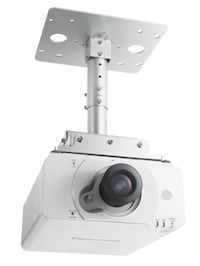
Panasonic's DZ570U projector offers a resolution of 1,920 x 1,200 and a brightness of 4,000 lumens. |
Panasonic has debuted a new series of single-chip DLP projectors designed to deliver high light output for medium and large venues.
The PT-DZ570U projector, the flagship model in the series, delivers 4,000 lumens of brightness coupled with a super-HD resolution of 1,920 x 1,200 and a contrast ratio of 2,000:1. It also includes a variety of technologies for enhancing image quality (such as Panasonic's RGB Booster with Vivid Color Control technology) and a technology called Daylight View Premium, which is designed to adjust images in real time to mae them pop in high ambient light environments.
Other features include:
- RJ-45 LAN connectivity (10Base-T/100Base-TX);
- 2x optical zoom (manual focus);
- ±40 degree vertical keystone correction;
- +60 percent vertical lens shift and ±10 percent horizontal lens shift;
- DICOM simulation mode;
- Rec. 709 mode, designed for enhanced reproduction of HDTV sources;
- An integrated waveform monitor for use in image correction;
- Detail Clarity Processor 3 for image correction; and
- Optional wireless connectivity.
AV inputs include BNC5, mini D-sub 15-pin (RGB), DVI-D, HDMI, S-video, and composite video, as well as stereo RCA audio jacks and dual stereo minijacks. It also includes a stereo minijack out and nine-pin serial and remote terminals.
Panasonic also launched lower-end high-light-output projectors in its large-venue lineup, including the PT-DW530U (1,280 x 800, 4,000 lumens) and the PT-DX500U (1,024 x 768, 4,500 lumens).
The PT-DZ570 series is expected to be available in late November or early December. The PT-DZ570U will list for $11,999, though street prices will be considerably lower. Further information can be found here.
| Editor's note: This article has been modified since its original publication to correct a factual error. We previously reported the lens shift figures in degrees (+60 degrees vertical and ±10 degrees horizontal). Representatives from Panasonic have informed us that these figures were supposed to be percentages, not degrees. [Last updated Nov. 18, 2010 at 11:08 p.m.] --David Nagel |