How Colleges Are Connecting the Student Lifecycle to Improve Student Success
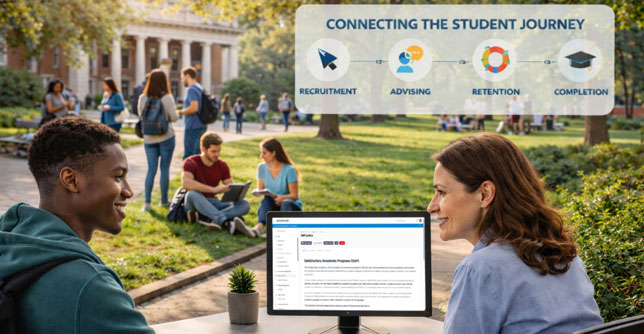
Colleges and universities are taking a more connected approach to student success. Instead of treating recruitment, onboarding, advising, and retention as separate efforts, many institutions are aligning these stages into a single student lifecycle.
This approach reflects how students experience college. From their perspective, enrollment, coursework, advising, and support are all part of one journey. When systems and teams work together, that journey becomes clearer and easier to navigate.
Across higher education, lifecycle alignment is helping colleges improve communication, reduce friction, and use resources more effectively.
Moving From Stages to a Continuous Experience
For decades, colleges organized student services around offices and functions. Enrollment teams managed applications. Advising teams focused on academic progress. Student services responded to questions and issues.
Each function worked well on its own. Over time, however, students began to feel the gaps between stages. They repeated information. They received messages that were not always aligned. Staff often lacked visibility into earlier interactions.
Institutions are now addressing this by connecting systems and processes across the student lifecycle. When teams share context, support becomes more consistent. Conversations become more productive.
Research from the Community College Research Center shows that guided pathways and coordinated student support improve clarity and persistence, especially for community college students.
These findings have influenced institutions of all sizes, not just community colleges.
Focusing on Critical Transition Points
Lifecycle alignment places special emphasis on transitions. These moments often determine whether students persist.
Key transitions include:
- Moving from applicant to enrolled student
- Completing the first term
- Entering a major or program of study
- Preparing for graduation or transfer
Colleges are using connected data and shared workflows to support students during these moments. Enrollment information can inform early advising. Academic alerts can trigger outreach before problems escalate. Service requests can reveal patterns that guide intervention.
National data supports this approach. The National Student Clearinghouse Research Center reports that persistence improves when institutions engage students early and maintain consistent support throughout the academic year.
These insights help institutions focus attention where it has the greatest impact.
Strengthening Collaboration Across Campus
Lifecycle alignment also changes how teams work together. Enrollment, advising, student services, and IT increasingly share responsibility for student outcomes.
Technology supports this collaboration by providing shared views of student activity. Staff can see prior interactions and tailor conversations accordingly. This reduces duplication and saves time.
Leadership structures are evolving as well. Many colleges are forming cross-functional groups to oversee student success initiatives. These groups help align goals, policies, and metrics.
The American Council on Education has emphasized that cross-campus collaboration is essential to improving student success and institutional effectiveness.
When collaboration becomes routine, lifecycle alignment is easier to sustain.
Using Data With Intent
Data plays a central role in connecting the student lifecycle. Institutions are moving away from static reports and toward timely, actionable information.
The emphasis is on relevance. Staff need data that supports decisions and conversations, not just dashboards. When information is shared responsibly across teams, support becomes more proactive.
EDUCAUSE research highlights that institutions see stronger results when analytics are aligned with clear goals and embedded into everyday workflows.
Privacy and security remain foundational. Colleges apply existing data governance frameworks to lifecycle data use. This ensures compliance while enabling insight.
When data use is transparent and purposeful, trust grows among students and staff.
Technology as an Enabler
Technology enables lifecycle alignment, but it does not drive it. Successful institutions begin with strategy and design systems to support that strategy.
Some colleges modernize student portals to unify communications, advising, and services. Others integrate existing tools through shared workflows and data standards.
Technology partners often support this work by helping institutions configure systems that reflect institutional structure and compliance needs. As one example, Canyon GBS supports colleges seeking to strengthen lifecycle engagement through coordinated, compliance-aligned student support systems.
In these efforts, institutions retain control over policies, workflows, and priorities.
What's Next
Connecting the student lifecycle is an ongoing practice, not a one-time initiative. As student needs evolve, institutions refine how they align services and information.
The progress so far is encouraging. Colleges are creating experiences that feel more coherent and supportive. Staff are working with better context and shared purpose.
By viewing the student lifecycle as a connected whole, institutions are strengthening relationships with students and improving outcomes. This work reflects a broader commitment to clarity, collaboration, and continuous improvement in higher education.