Coppin State U Houses 500 Kilowatt Solar Plant
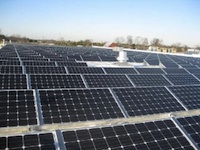
The portion of the installation housed at Anne Arundel County's Combined Support Services Complex, pictured here, will generate 900,000 kilowatt hours of energy per year. |
Baltimore's Coppin State University is the site of a new 500 kilowatt photovoltaic plant that will go online this spring. It's part of a larger, multi-site, 1.25 megawatt solar construction project that will provide energy at a reduced price for both the campus and the county of Anne Arundel in Maryland.
The construction will actually involve two installations, a 500 kilowatt plant on campus and a 750 kilowatt plant in a complex housing service and maintenance facilities for neighboring Anne Arundel County. The installations are being funded partially by a grant from the state of Maryland's Project Sunburst initiative and will be financed, owned, and operated by Constellation Energy, according to information released by the vendor.
Using funding made available to the state of Maryland through the American Recovery and Reinvestment Act, Project Sunburst, operated out the Maryland Energy Administration, promotes the use of public facilities to house clean energy installations, with project partners contracting out for the electricity generated via power purchase agreements. Under the program, organizations that house the installations receive contracts to purchase the generated power at reduced rates, allowing organizations like Coppin State U to to further their commitment to green energy while also providing a financial benefit to the host institutions.
"All of our facility improvements and new construction have a focus on sustainability and energy conservation," said Maqbool Patel, director of facilities management at Coppin State University, in a prepared statement. "This is part of a larger effort to contain costs and maximize resourcefulness of campus resources during this period of fiscal austerity."
According to information released by Constellation Energy, "Coppin State University's on-site solar power system will supply electricity for its new Physical Education Complex, utilizing approximately 2,040 roof-mounted crystalline photovoltaic solar panels. The system is expected to supply more than 600,000 kilowatt-hours of electricity annually."
Maryland's Project Sunburst has awarded grants to several other education institutions in Maryland in the last year, including Anne Arundel Community College (for a 750 kilowatt installation), Frederick County Public Schools (500 kilowatts), Garrett County Public Schools (500 kilowatts), Harford County Public Schools (452 kilowatts), Saint Mary’s County Public Schools (497 kilowatt), and Washington County Public Schools (444 kilowatt).