6 Ingredients for the 21st Century Classroom
- By Bridget McCrea
- 01/11/12
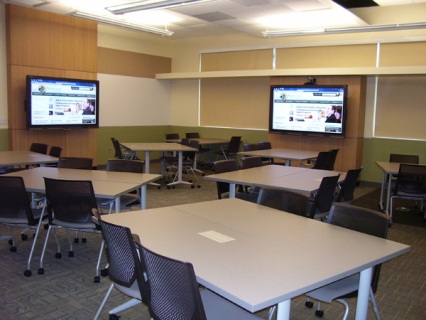
Saint Leo University's 21st century classroom |
Just stuffing classrooms with gadgets isn't going to result in real 21st century learning spaces. Today's institutions must design classrooms that fully support technology and foster a collaborative learning environment. Here are six ways you can transform your classrooms into next-generation learning spaces.
- Start with the physical shell. High ceilings, adequate lighting and lighting controls, open room layouts, and raised flooring are just a few of the elements that go into all of the University of Pittsburgh's Swanson School of Engineering high-tech classrooms. Classroom access is at the back of the room to reduce the number of outside distractions and an open layout allows teachers and students to move around freely and collaborate with one another. "When you start with the shell and then move to the student and instructor casework the technology itself becomes secondary," said Brian Vidic, director of technology. "The end result is a space that can flex and accommodate different types of instruction."
- Eliminate shadows and dark spots. Unlike traditional rooms where blackboards were the focal point, the 21st century room has to accommodate different types of projections and displays that instructors use during the course of a day. "When designing the spaces," said Vidic, "we look for any dark spots or shadows and try to eliminate them while giving instructors the power and control they need to be able to adjust the lighting accordingly."
- Maximize seating arrangements. The days when students sat at individual desks and pored over their own individual assignments are long gone. Today's college classroom is teeming with collaborative opportunities. The casework and furniture has to support that trend. At the University of Pittsburgh, for example, the newest rooms include crescent moon-shaped casework that accommodates up to six students. The furniture also has to be flexible enough to be used for standard, paper-based testing when needed. "Look for casework and/or desks that can meet the students' computing and traditional needs," Vidic advised. "This helps keep costs down and allows classrooms to be used for a variety of functions."
- Get faculty involved in the process. Faculty members played an important role in the design of the new Donald R. Tapia School of Business at Saint Leo University in Saint Leo, FL. The $12 million facility includes a 60-seat executive lecture hall, six classrooms, three seminar rooms, and two computer labs. Every classroom is equipped with 70-inch, HD LCD multi-touch displays. Susan Colaric, assistant vice president for instructional technology, said faculty input and feedback was taken seriously and integrated into the overall design of the new building. "The most important ingredient for any 21st century classroom is the faculty," said Colaric. "When you identify their desires, needs, and concerns and take them seriously, you can create a top-notch facility."
- Provide easy ways to "power up." Textbooks and notebook paper don't require electrical outlets and USB ports to operate but laptops, iPads, audiovisual equipment, and interactive displays do. Take this into consideration during the design process as it can be expensive and disruptive to have to add outlets and ports at a later date. In St. Leo University's new building, for example, every teacher podium includes five USB slots that are used to load data from student flash drives before class starts. "That's a convenience that frees up more time for class activities," said Colaric. All student desks are mobile and include a power cord that can charge multiple devices. She sees this as a necessity in the 21st century classroom where "students always have their laptops, but not always charged and ready to use."
- Design with the student-instructor dynamic in mind. Avoid filling rooms with standalone pieces of technology that claim to be the next best thing for higher education. Instead, said Vidic, look for technology that enhances and supports the student-instructor dynamic. "Don't sacrifice the learning component in favor of new tools and applications," stated Vidic. Desks, computers, monitors, and keyboards should be positioned in a way that allows the professor to teach in either a traditional or 21st century manner. "As you design the room make sure you're delivering a suitable classroom teaching environment," said Vidic. "Then start laying the technology on top of that foundation."
|
Kissing the Podium Goodbye
When Swanson School of Engineering's new classrooms were in the design phase there was much debate over whether the teacher podium should stay or go. Was it a relic that was no longer relevant in the 21st century classroom, or was it still a necessity in the modern-day teaching facility? Brian Vidic, director of technology, said the school had slowly moved away from its 8-foot by 2-foot "massive instructor stations" over the previous eight years, but it still faced the decision to either get rid of them completely or keep them in the classroom.
"Basically we're trying to get away from using physical structures that serve as podiums," remarked Vidic, whose team has tested out collapsible podiums and those that include articulating arms and other innovative features. "Physically reducing the size of the podium forces instructors to get out from behind it and interact with the class."
Other elements that no longer fit well with the 21st century classroom include auditorium-style rows upon rows of computers. "We still have one classroom set up that way and instructors do what they can to schedule around it," said Vidic. "It just doesn't promote the collaborative environment that instructors are striving for."
Finally, Vidic said hardware-controlled systems are being replaced in favor of software-controlled options that require no cables. "Hardware-controlled systems have so many points of failure," said Vidic. "Over the next few years they'll continue to make their way out of the classroom. With software-based systems there's much cleaner, more intuitive management for the faculty and IT support staff." |
About the Author
Bridget McCrea is a business and technology writer in Clearwater, FL. She can be reached at [email protected].