Wearable Learning
Technologies like Google Glass have great educational potential — with or without the high-priced hardware.
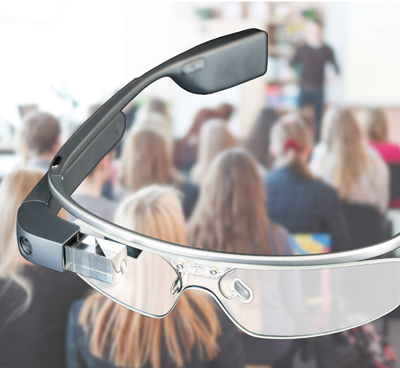
Photo: Shutterstock.com |
When you think about the learning potential of wearable technology, the first thing that typically comes to mind is students, well, wearing it. A student might use a head-mounted GoPro camera to film a first-person narrative, or perform chemistry experiments informed by a Google Glass overlay.
Along the same lines, most of the futurist thinking regarding wearables seems to revolve around what can be done with the hardware: how students can engage by wearing the devices. When the Educause Learning Initiative assessed the implications for teaching and learning in its "7 Things You Should Know About Wearable Technology," for example, the organization pointed out, "Wearable cameras … allow a learner to engage simultaneously as observer, reporter and participant, enabling more detailed life-blogging and providing a subjective point of view for digital storytelling."
The 2014 New Media Consortium Horizon Report took a slightly different approach in its predictions on wearables, focusing on the "quantified self" (the phenomenon of using technology like wearables to track personal lifestyle data): "It is imaginable that if test scores and reading habits gleaned from learning analytics could be combined with other lifestyle tracking information, these large data sets could reveal how environmental changes improve learning outcomes." That is a fascinating idea, but it's still based on students actually wearing the devices to collect their lifestyle data.
I would argue that there's another, more immediate educational use for wearables, one that students can benefit from even without laying their hands on the hardware: dreaming up software for the devices. In this month's story on using Google Glass in the classroom, we found three early-adopter institutions encouraging students to design apps for the head-mounted technology. A course at Northeastern University, for instance, challenges students to create Glass apps that will help people make behavioral changes to improve their health. It's an ingenious way to engage students and hit all the right education buzzwords — project-based learning, digital literacy and futurist technology rolled into one. Even better, the focus on software means students don't have to fork out $1,500 for their own Glass headset (not exactly affordable in a world of skyrocketing tuition and textbook costs).
Still, while Glass may be cost-prohibitive for most students right now, it's important to recognize that wearable devices could go mainstream fast. "In a year, 30 percent of people could have some form of wearable tech," predicted William Ward, social media professor at Syracuse University, in our story. "The mobile phone is dead. Wearables are emerging. They will take over eventually."
About the Author
Rhea Kelly is editor in chief for Campus Technology, THE Journal, and Spaces4Learning. She can be reached at [email protected].