RIT to Launch Virtual/Augmented Reality Lab
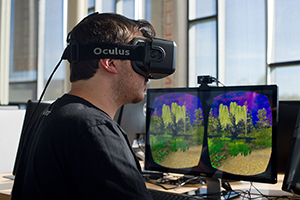
An RIT student using the Oculus Rift virtual reality headset (photo by A. Sue Weisler)
In January, Rochester Institute of Technology's Center for Media, Arts, Games, Interaction and Creativity (MAGIC) plans to launch a new virtual/augmented reality lab dedicated to "enhancing the content of virtual/augmented reality platforms in order to provide users with top-notch experiences."
A collaborative project among computing, arts and humanities, the lab will provide faculty and students with development facilities, hardware platforms and experimental devices that utilize motion, touch and sensory interfaces, according to a statement from the university. It will also offer opportunities for the general public to experience VR and AR interfaces firsthand.
The lab will also play a crucial role in the emerging field of content development for VR/AR platforms and will help fuel multi-disciplinary connections, said Andrew Phelps, director of RIT's Center for MAGIC and the founder of RIT's School of Interactive Games and Media. RIT students and researchers have developed a number of virtual reality projects across the institution, and the lab will serve as a central home for those efforts.
"RIT has a long and engaged history with the development of user interfaces and enhancement of user experiences, especially when we examine the contributions of our alumni and projects that are key components of our MAGIC Spell Studios initiative," said Phelps in a statement. "Additionally, there are significant open source efforts surrounding these interfaces and, through our free and open source software (FOSS@RIT) initiatives, we plan to be highly involved in this evolution through open research projects, code contribution, hackathons, home-brew hardware exploration and community engagement and outreach."
About the Author
Rhea Kelly is editor in chief for Campus Technology, THE Journal, and Spaces4Learning. She can be reached at [email protected].