OER Use to Triple Over Next 5 Years
Open educational resources (OER) are replacing primary courseware in higher education, with the potential to triple in use over the next five years — from 4 percent to 12 percent of the primary courseware market. The use of OER for supplemental learning materials is expected to quadruple in size as well, jumping from 5 percent to 19 percent.
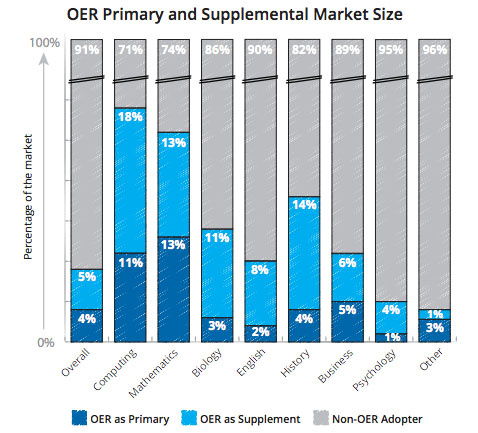
Mathematics and computing OER were the most adopted subjects, while English and psychology were the least adopted subjects. Source: Cengage Learning.
These findings and more were published in a new report from Cengage Learning titled “Open Educational Resources and the Evolving Higher Education Landscape,” in which the education company surveyed more than 500 teaching faculty, industry experts and OER primary adopters, supplemental adopters and non-adopters.
Considering that one in five college students has skipped or dropped out of a class due to the price of required learning resources, instructors are looking for less expensive, quality course materials. There is also an increased willingness among instructors to diversify course content. Coupled with the “power of the internet,” the report explains, these factors are driving the OER trend in higher education. Additionally, funding from major foundations and other sources has gone toward supporting OER initiatives. The report cites The William and Flora Hewlett Foundation as an example, which has funded 177 OER-related projects in K–12 and higher education since 2002.
Still, OER remains largely unknown to many educators. The report cites another survey, sponsored by the Independent College Bookstore Association, in which 39 percent of respondents indicated “that they had never heard of OER” and 36 percent “knew a little about OER but had not used or reviewed OER materials.” Another recent survey from Babson College found that 58 percent of respondents were “not aware” or “had never heard of OER.”
For educators who are aware, the main obstacles to adopting OER include finding quality resources; concerns about unknown permissions; and difficulty integrating OER. The most significant barrier is “a faculty perception of the time and effort required to find and evaluate it,” according to the report. Respondents cited the lack of a comprehensive catalog (51 percent) and challenges finding what is needed (42 percent) as the biggest obstacles.
Other key findings include:
- Mathematics (13 percent) and computing (11 percent) OER were the most adopted subjects, while English (2 percent) and psychology (1 percent) were the least adopted subjects;
- Among faculty who are not currently using OER, a majority (77 percent) responded they either expect to use OER or would consider using OER; and
- More than 35 states already have grants or policy supporting OER creation and adoption.
The full report can be viewed on the Cengage site.
About the Author
Sri Ravipati is Web producer for THE Journal and Campus Technology. She can be reached at [email protected].