Immersive Learning - The Media Grid Immersive Education Initiative
- By Mary Grush, Matt Villano
- 07/28/09
The key to effective use of a 3D immersive environment for education may be an intuitive, natural mode of interaction for its users. Working with the Media Grid Immersive Education Initiative, an international nonprofit consortium of education institutions, Aaron Walsh, director of The Grid Institute and a faculty member at Boston College, led a collaboration with the Mixed Reality Lab at the National University of Singapore to develop a tool to merge 3D virtual and physical worlds: the Immersive Education Mixed Reality Table (iED Table). Wearing 3D goggles, students can interact physically with a 3D immersive virtual environment that “pops up” from the 2D surface of the iED Table.
“The iED Table dramatically changes the way in which students interact with computer-based learning environments by combining, or ‘mixing,’ the real world with the virtual world,” Walsh explains. “This innovation in human-computer interaction is achieved by superimposing synthetic 3D virtual worlds and objects onto any surface in the real world, such as a table, desk, or floor. Students use their hands and bodies to interact with the virtual worlds and objects that appear on the iED Table in the same way that they interact with real-world objects. Virtual learning environments can be interacted with in a natural and intuitive way that enhances the overall learning experience.”
A major development priority is to make the iED Table compatible with virtual platforms in use around the globe.
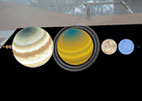
Though the iED Table is a brand-new introduction, a few simple, concrete demonstrations of the newly announced table are already providing a starting point for development of curricular applications of the technology in higher education. In one demonstration, astronomy students not only learn about the solar system, but also interact with a 3D virtual model and design experiments on the fly. Students place a virtual sun and planets onto a real tabletop—set in physical space in their classroom. By changing the size of the planets and their relative positions to the sun, the students can observe the effects of mass and gravity on their virtual planets’ orbits. Students can devise a wide range of “what if” scenarios as they interact directly with the model, moving planets around at will and changing the size and mass of the planets and the sun. Students also can cut the planets and sun open, exposing inner structures such as the core and layers of the earth or the molten materials inside of the sun.
In another example, botany students can run seed germination experiments with virtual versions of some of the same laboratory supplies they’d use in a physical lab. Though such experiments could also be run exclusively in “real” physical spaces, using the iED Table offers many advantages in setting up and modifying variables quickly and efficiently. For instance, students may watch the sprouts emerge from the soil and grow into full-sized plants in a time-lapse sequence, then reset their variables and begin again—several times during the course of one lab period.
A major development priority for the Media Grid Immersive Education Initiative is to make the table compatible with virtual platforms in use around the globe. By using Immersive Education Initiative technology standards, the iED table will interact with a wide range of virtual platforms, such as Project Wonderland from Sun Microsystems, realXtend, and Open Cobalt. Practicality and price point were also important priorities in the development of the table, as Walsh expects the technology to be affordable and used widely. The Media Grid Immersive Education Initiative’s ultimate goal is to offer the table as a commercial-grade technology free of charge to the global academic community.
About the Authors
Mary Grush is Editor and Conference Program Director, Campus Technology.
Matt Villano is senior contributing editor of this publication.