9 Universities Help Farmers Increase Climate Data Yield
- By Dian Schaffhauser
- 04/14/14
Nine universities in the Corn Belt region of the United States have teamed up to develop two online big data tools to make climate information available to the agriculture community. AgClimate View provides quick access to historical climate and crop data. Growing Degree Days (GDD) Tool tracks real-time and historic GDD accumulations. GDDs are a measure of heat accumulation that helps farmers to predict plant development rates and maturity dates. Development of the programs called on the disciplines of applied climatology, crop modeling, agronomy, cyber technology, agricultural economics and other social sciences.
The project was funded by the United States Department of Agriculture's National Institute of Food and Agriculture and includes participation from Purdue University, which leads the team, as well as Iowa State University, Michigan State University, South Dakota State University, University of Illinois, University of Michigan, University of Missouri, University of Nebraska-Lincoln and the University of Wisconsin. Non-institutional contributors include High Plains Regional Climate Center, Midwestern Regional Climate Center and the National Drought Mitigation Center.
| |
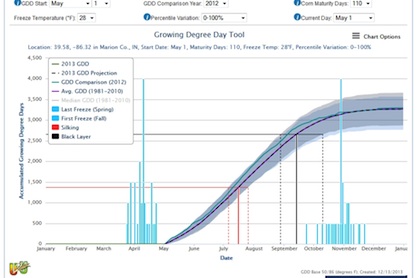
The Growing Degree Days Tool tracks heat accumulation data to help farmers predict plant development rates and maturity dates. |
|
AgClimate View plots local temperature and precipitation variation as far back as 1980. It tracks county crop yields and trends and analyzes crop yields in the context of temperature, precipitation, and GDD data. When used along with other data, the application can help the farmer identify long-term correlations between climate trends and yields and put recent crop activities into historical context.
The GDD program puts current conditions into a 30-year historical perspective and provides trend projections through the end of the calendar year. It enables users to assess climate risks, such as the likelihood of early or late frosts or freezes; perform activity planning such as projections regarding seed purchasing; and make decisions on pricing and crop insurance.
The Useful to Usable or U2U site also includes other decision-support resources such as a corn nitrogen calculator, a nitrogen watch, irrigation scheduling and a cover crop decision tool.
"We're excited to announce the launch of our first of several decision-support tools," said Linda Prokopy, associate professor of forestry and natural resources at Purdue, who leads the team. "Our social science research on the front end helped our team create easy-to-use tools that make climate data accessible and useful to the agricultural community. We'd like to think we are demystifying climate data one user at a time and hope producers will use the information to make better decisions and ultimately increase yields with minimal environmental impact."
The potential users — farmers and farm advisors — provided feedback throughout the development process, according to Tonya Haigh, a rural sociologist at the Drought Mitigation Center who helped conduct surveys of farmers and farm advisers. Preliminary focus groups in Nebraska in early 2013 helped determine which tools to make first, and later focus groups in the summer and fall helped refine prototypes.
About the Author
Dian Schaffhauser is a former senior contributing editor for 1105 Media's education publications THE Journal, Campus Technology and Spaces4Learning.