Colorado’s Online Professional Learning Platform Integrates Video Coaching

The Colorado Education Association (CEA) is embedding video observation and feedback into its online professional development (PD) platform called COpilot.

The statewide federation CEA — comprised of 35,000 K–12 teachers and education support professionals, higher education faculty and support professionals, retired educators and college students studying to become teachers — launched COpilot last February to give its members access to online classes with peer-to-peer teacher support. The CEA is the first state affiliate of the National Education Association to roll out such a platform.

COpilot now offers video-powered PD through Edthena. Educators can use the platform to upload videos of their classroom instruction and then share those videos with coaches who can give timestamped comments categorized as questions, suggestions, strengths and notes.
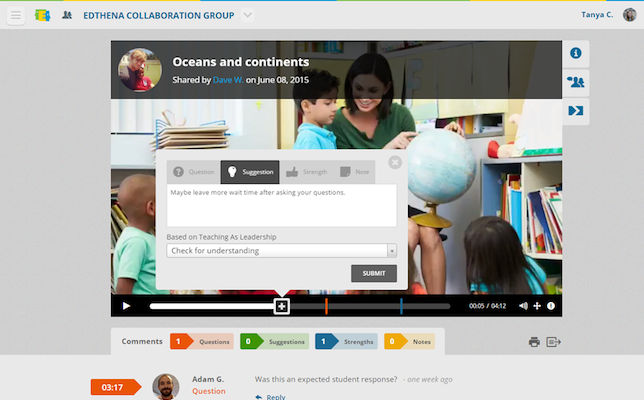
Coaches can add timestamped comments on videos to offer instructional support to teachers. Image: Edthena.

“With Edthena, teachers who are taking classes on COpilot can collaborate with each other in a unique and personalized way, which is something many of them have never experienced,” wrote Casey Kilpatrick, dir ector of learning services at the CEA, in the blog post announcement. “Edthena really is the best video coaching platform we looked at. It adds cutting-edge technology to our teachers’ experience.”

Several Colorado educators presented on Edthena integration at the recent Colorado Education Association Leadership Conference, which can be seen below. Further information is available on the Edthena blog.

About the Author

Sri Ravipati is Web producer for THE Journal and Campus Technology. She can be reached at [email protected].

Featured

  • Digital clouds with data points and network connections

    Microsoft Makes Windows 365 Cloud Apps Available for Public Preview

    Microsoft has announced that Windows 365 Cloud Apps are now available for public preview. This allows IT administrators to stream individual Windows applications from the cloud, removing the need to assign Cloud PCs to every user.

  • university building with classical architecture is partially overlaid by a glowing digital brain graphic

    NSF Invests $100 Million in National AI Research Institutes

    The National Science Foundation has announced a $100 million investment in National Artificial Intelligence Research Institutes, part of a broader White House strategy to maintain American leadership as competition with China intensifies.

  • Hand holding a stylus over a tablet with futuristic risk management icons

    Why Universities Are Ransomware's Easy Target: Lessons from the 23% Surge

    Academic environments face heightened risk because their collaboration-driven environments are inherently open, making them more susceptible to attack, while the high-value research data they hold makes them an especially attractive target. The question is not if this data will be targeted, but whether universities can defend it swiftly enough against increasingly AI-powered threats.

  • school building connected by lines to symbols of AI, data charts, and a funding document with a dollar sign

    ED Issues Guidance on the Use of Federal Grant Funds to Support Learner Outcomes with AI

    In response to President Trump's April 23 Executive Order on advancing AI education, the United States Department of Education has issued new guidance on how K-12 and higher education institutions may use federal grant funds "to support improved outcomes for learners through the responsible integration of artificial intelligence."