Study: 1 Coding Bootcamp Graduate for Every 3.5 University Grads
Infographics: Course Report.
The five-year coding bootcamp industry estimated at $266 million is rapidly expanding, according to a new market study from Course Report.
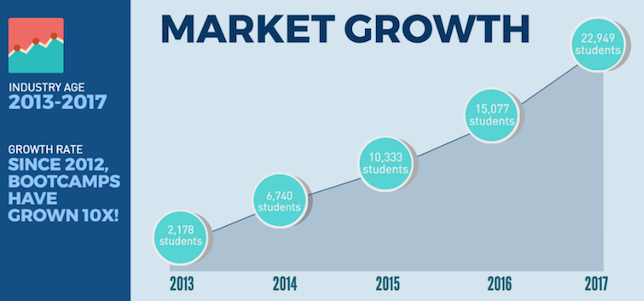
The study counted 94 full-time coding bootcamps across the United States and Canada (with programs in 74 U.S. cities). Compared to 2012, there will be 10 times as many graduates this year — or roughly one coding bootcamp graduate for every 3.5 graduates from a traditional university or college. Course Report estimates that 22,814 developers will graduate from coding bootcamps this year — an increase from 15,048 graduates last year.
Why are students enrolling in coding bootcamps? One reason may be the adaptability of these accelerated computer science programs, where students are taught web and mobile development skills that align with industry demands. Programs are offered in-person or online, providing students with flexible learning options. The payoff is decent too: At a typical coding bootcamp, Course Report estimates average tuition is $11,400 for about 14 weeks of instruction, from which the majority students complete on-time and find relevant jobs.
However, as the market gets crowded, not all of these businesses will succeed. Last year saw 15 open and six shut down, the report noted. In addition, Dev Bootcamp and The Iron Yard, both early entrants, closed locations in a combined 25-plus U.S. cities this year citing a similar reason: struggling business models.
“Since launching in 2012, we’ve been striving to find a viable business model that would enable us to further our vision of high-quality, immersive coding training that is broadly accessible to a diverse population, while also covering the critical day-to-day costs of running our campuses,” Dev Bootcamp wrote in a farewell post. “Ultimately, we have been unable to find a sustainable model that doesn’t compromise on one of those fronts.”
Meanwhile, the thriving ones are teaching Full Stack JavaScript, according to the report. JavaScript suprasses Ruby on Rails; it is reportedly taught as a primary programming language at 39 percent of web development programs, which encompasses 91 percent of all bootcamp grads. “Not only are schools new to the market choosing JavaScript, but established bootcamps are also migrating their curricula to emphasize JavaScript,” Course Report noted in the report. Meanwhile, for students focused on mobile development (about 5 percent of bootcamp grads), nearly 48 percent are learning iOS with Objective-C.
The “The 2017 Coding Bootcamps Market Size Study” is Course Report’s fourth Market Sizing Report. All data is based on surveys with nearly every full-time, in-person coding bootcamp in the U.S. and Canada (about 98 percent of programs), as well as graduation rates.
About the Author
Sri Ravipati is Web producer for THE Journal and Campus Technology. She can be reached at [email protected].