Brown U Students Develop VR History Experience for Use in Education
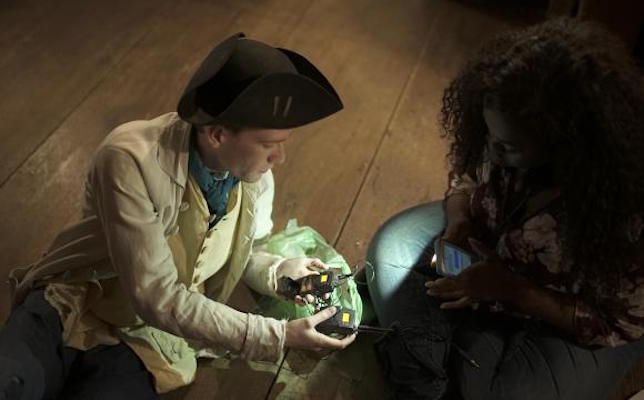
Brown University students in Adam Blumenthal's group independent study project prepare for a shoot. Image Credit: Adam Hersko-RonaTas.
A group of students led by a virtual reality artist-in-residence at Brown University have created a VR experience that aims to bring a bit of history to life for middle and high school students.
Beginning in May 2016, Adam Blumenthal led a team of 14 undergraduate students from more than a dozen majors (or concentrations, as Brown refers to them) in an independent study project designed to bring the Gaspee Affair to virtual reality.
"They were great collaborators," said Blumenthal, according to a university report about the project. "What I taught them was how an interactive media production works, from concept to almost completion."
An early act of rebellion in 1722 leading up to the American Revolutionary War, the Gaspee Affair was an incident in which colonists in Rhode Island boarded a Royal Navy schooner, the HMS Gaspee, and lit the ship afire in retaliation for its captain's harassment of colonial fishermen and merchants.
As a result of the project, middle and high school students will be able to experience American history up close, by "virtually entering a tavern where reenactors discuss plans to board the ship, traveling in a rowboat up Narragansett Bay toward the target, or listening in as officials debate how best to punish the colonists for their acts," according to information released by the university.
Blumenthal wanted to create the VR experience to help students understand what was at stake for the raiders who attacked the Gaspee, the university reported. "It wasn't just folly. They were about to commit treason and maybe murder. Some of them were very frightened, and they could have been captured and hung," he said.
"We were really focused in the beginning on how you could put this into a curriculum," said Zev Izenberg, a computer science and visual art concentrator. "By the end, we realized how difficult it was to create anything at all in VR … The hard stuff is getting it there in the first place."
To shoot the scenes for the project, the team used Google's 360-degree camera rig, which arranges 16 GoPro cameras in a circle to capture stereoscopic video which is then stitched together with Google software to create a sphere of video.
"Twelve to 24 hours after we shoot the footage, we can download it," Blumenthal said. "It's like stepping back in time, in a way, to the kind of filmmaking where you can't see what you've shot until later."
The project is being designed for use with HTC's Vive headset, which is at the high end of current VR technology.
"We're designing it for the best system with the most features so it's interactively rich," Blumenthal explained. "Because it's an experiment, really, we wanted to see, in the best-case scenario, what we could make."
Bowing to the reality that many schools and students do not have access to such expensive hardware, however, Blumenthal is also working on a version that uses Google Cardboard, a VR rig that can cost as little as $5 and is built from actual cardboard and works with a smartphone.
More information is available at blogs.brown.edu.
About the Author
Joshua Bolkan is contributing editor for Campus Technology, THE Journal and STEAM Universe. He can be reached at [email protected].