Copilot Propels Microsoft to Lead Position in Analytics/BI Market
A new Gartner report on the analytics/business intelligence market places Microsoft in the lead position of the field. The Redmond cloud giant stands apart and alone atop the axes for both the ability to execute and completeness of vision in Gartner's latest "Magic Quadrant for Analytics and Business Intelligence Platforms."
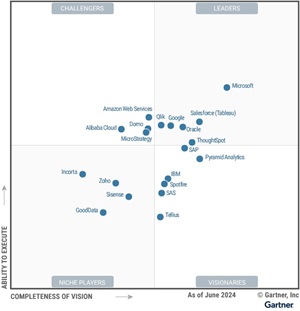 [Click on image for larger view.] Magic Quadrant for Analytics and Business Intelligence Platforms (source: Gartner).
Analytics/BI, of course, is a sweet spot for AI, and Gartner noted Microsoft's lead in that area due to its expertise in Copilots, or AI-powered assistants that now handle everything from coding web apps to scheduling meetings. The company now has dozens (hundreds?) of AI Copilots that leverage the game-changing tech in all manner of wares and services.
In fact, the Copilot brand was named one of the "strengths" of Microsoft's position in the new report, with Gartner noting it's now closely associated with generative AI.
"Starting with Copilot for Microsoft 365 and now moving onto Copilot for Power BI, Microsoft can leverage emerging generative AI technologies to drive adoption and accelerate the report creation process," Gartner said.
Report creation is just one of the yardsticks in the analytics/BI field, whose vendors offer mandatory features that Gartner said include:
- Data visualization: Support for highly interactive dashboards and the exploration of data through the manipulation of chart images.
- Governance: Governance capabilities track usage and manage how information is secured, shared and promoted.
- Reporting: This capability provides pixel-perfect, paginated reports that can be scheduled and burst to a large user community.
- Analytics catalog: Display of analytic content that makes it easy to find and consume. The catalog is searchable and makes recommendations to users.
- Data preparation: Support for drag-and-drop, user-driven combination of data from different sources, and creating analytic models (such as user-defined measures, sets, groups and hierarchies).
- Data science integration: Capabilities that enable augmented development and prototyping of composable data science and machine learning (DSML) models by citizen data scientists and data scientists with sophisticated integration into the broader DMSL ecosystem.
"Currently, one vendor — Microsoft — dominates the market in terms of user adoption," Gartner said. "The massive growth of the Microsoft Power BI cloud service has continued, fueled largely by the bundling of this product with Microsoft 365 (at E5 license level) at a greatly reduced price. The increasing integration of Power BI with Microsoft Teams fuels further growth, given the importance of remote working."
Surprisingly, Microsoft wasn't joined in the "Leaders" quadrant of the report by fellow cloud giants Amazon Web Services (AWS) and Google Cloud Platform (GCP), as has been the norm in recent AI-related reports and surveys. While Google did join Microsoft, Salesforce (Tableau), Oracle, ThoughtSpot and Qlik in the highest category, AWS was deemed a "Challenger," and hybrid cloud/AI specialist IBM (often grouped in with the "Big 3") was a "Visionary."
One note of interest: While the cloud giants usually rule the AI/analytics space these days, Microsoft's lack of an on-premises offering — it's Azure-only with its Power BI service — was listed as one of the company's "cautions."
"There was a major change in focus this year," Gartner said in its market overview. "Analytics and BI platforms traditionally have a visual drag-and-drop design interface. While this is still true, most vendors are now building a more conversational, text-based design interface where users simply type what type of reports they would like to see. These requests are still integrated with the ABI platform's query language and semantic layer, but with a more natural language interface based on generative AI and large language models to deliver a new report, data pipeline or query result.
"The presence of the major cloud ERP and CRM application providers is also an influencer of ABI platform selection considerations. On one hand, cloud-led sourcing creates inevitable concerns about lock-in and unforeseen costs of the data and analytics portfolio. On the other, the cloud service providers accept the importance of openness in their software stacks and the growing importance of "multicloud" approaches, whereby organizations run applications in, and across, multiple cloud offerings."
The full report is available to Gartner clients here.
About the Author
David Ramel is an editor and writer at Converge 360.