United States Leads in Stanford HAI Global AI Ranking
A new ranking tool from the Stanford Institute for Human-Centered AI (HAI) AI Index puts the United States in the No. 1 spot for global AI leadership. The Global AI Vibrancy Tool measures the strength of countries' AI ecosystems based on eight categories: research and development; responsible AI; economy; education; diversity; policy and governance; public opinion; and infrastructure. Each category is weighted by a panel of experts to determine an overall vibrancy score.
The tool gathers data based on 42 openly available AI-specific indicators, such as AI journal publications, total AI private investment, AI legislation passed, and foundation model datasets, HAI explained in a news announcement. The tool is "designed to empower policymakers, industry leaders, researchers, and the public with actionable, data-driven insights into national AI development."
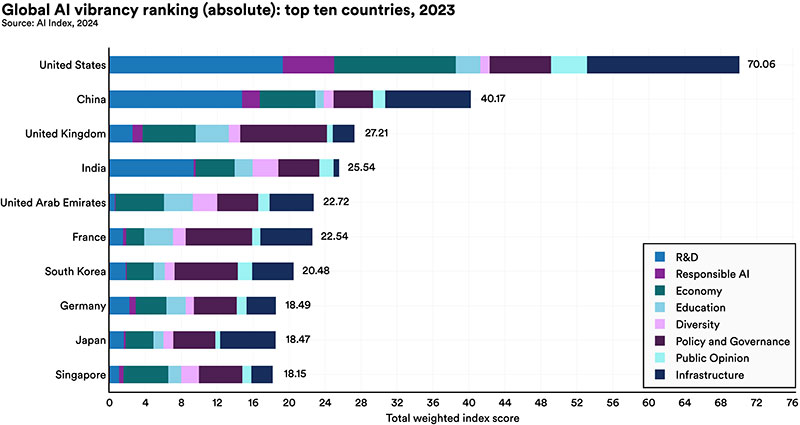 [Click on image for larger view.]
Top 10 countries in the AI Index's Global AI vibrancy ranking
This year's top 10 countries are:
- United States
- China
- United Kingdom
- India
- The United Arab Emirates
- France
- South Korea
- Germany
- Japan
- Singapore
"AI has increased as a topic of national interest, and correspondingly narratives about which countries lead in AI have become more prominent than ever," said Nestor Maslej, project manager of the AI Index, in a statement. "However, there's limited data providing a clear, quantitative view of where countries actually stand in AI. At the Index, we wanted to address this gap with a rigorous tool that could help policymakers, business leaders, and the public ground these geopolitical AI narratives in fact."
The tool will be updated regularly, HAI said, to serve as a resource for tracking global AI development. It can be accessed on the AI Index site here.
About the Author
Rhea Kelly is editor in chief for Campus Technology, THE Journal, and Spaces4Learning. She can be reached at [email protected].