Report: AI Adoption Leads to Retraining, not Replacing, Workers
Despite fears that artificial intelligence will lead to major workforce reductions, a new report from the Federal Reserve Bank of New York suggests that's not happening happening ... yet. In "Are Businesses Scaling Back Hiring Due to AI?," the bank found that while AI adoption has increased across industries, most firms are retraining employees rather than replacing them.
It bucks a lot of industry buzz, with cloud giants like Microsoft, Google, and Amazon undergoing rounds of layoffs in parallel with large AI investments. For example, in 2025 alone Amazon has committed more than $45 billion to AI infrastructure and hardware projects, with CEO Andy Jassy noting in a memo reported by Business Insider, "As we continue to invest in generative AI, we do expect that some roles — especially in corporate functions — will evolve or no longer be needed."
The NY Fed is one of 12 regional banks in the U.S. Federal Reserve System that oversee monetary policy implementation, financial supervision, and economic research. And some of that research, published last month, sheds some data-based light on the matter.
"Businesses reported a notable increase in AI use over the past year, yet very few firms reported AI-induced layoffs," said the report published by Liberty Street Economics, a research blog published by economists at the NY Fed. "Indeed, for those already employed, our results indicate AI is more likely to result in retraining than job loss, similar to our findings from last year."
However, the blog also provides counterpoint warnings for the future, with 13% of service firms expecting layoffs due to AI over the next six months. Also, nearly a quarter of such firms that are planning to use AI expect to hire fewer workers.
"This is consistent with findings from a Dallas Fed regional survey, which found that 10% of business executives reported that AI decreased their need for workers. Interestingly, the reduction in hiring due to AI was concentrated among jobs that require a college degree."
So all the angst about "AI taking my job" may well be realized soon.
The report, with data gathered in August, compared AI usage among service and manufacturing firms, revealing some interesting divides between the two market segments.
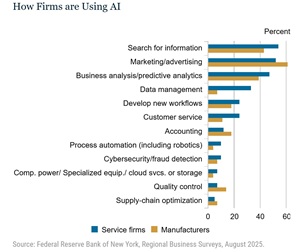 [Click on image for larger view.] How Firms are Using AI (source: Federal Reserve Bank of New York).
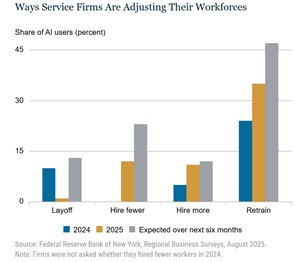 [Click on image for larger view.] Ways Service Firms Are Adjusting Their Workforces (source: Federal Reserve Bank of New York).
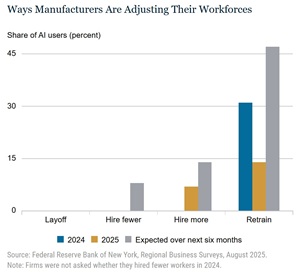 [Click on image for larger view.] Ways Manufacturers Are Adjusting Their Workforces (source: Federal Reserve Bank of New York).
Balancing out the decline in hiring, 11% of service firms and 7% of manufacturers reported increasing their workforce because of AI. Additionally, between 10% and 15% of firms in both categories anticipate hiring more employees due to AI in the coming six months. These new hires tend to be individuals with college degrees, aligning with recent findings from the Atlanta Fed. While relatively rare, some companies that reduced hiring or conducted layoffs also brought on new staff, highlighting the nuanced and multifaceted impact of AI on workforce dynamics.
Although firms using AI have begun adjusting their workforces, the survey data reflects only the 25-40% of businesses currently adopting the technology. As a result, any broader labor market effects are expected to be limited for now, with no clear signs of widespread job losses. In fact, employees are more often retrained than replaced, and AI has opened up new roles for those with relevant skills. Still, some job seekers may face tougher prospects as certain firms reduce hiring. Looking ahead, companies foresee deeper layoffs and slower hiring as AI integration progresses.
In August, the New York Fed surveyed businesses in the New York-Northern New Jersey area to assess their recent and anticipated use of AI across functions like marketing, analytics, data handling, and customer service. Companies that used AI solely for information lookup were excluded from the count.
In summary, as AI adoption accelerates, the labor market story remains one of transition rather than disruption — at least so far, the report states. The NY Fed's findings suggest that retraining and role evolution are more common than outright displacement, but the projected uptick in layoffs and hiring slowdowns signals that the equilibrium may shift. For workers and employers alike, the challenge will be navigating this evolving landscape with agility, ensuring that technological gains don't come at the cost of workforce resilience.
The full NY Fed report is available here.