Report: 95% of IT Leaders Encounter Unexpected Cloud Storage Costs
According to new research commissioned by storage and data backup company Backblaze, hidden fees continue to undermine the predictability of cloud storage spending.
The report, titled "The Hidden Cost of Cloud Storage: What 400+ IT Leaders Wish They Knew Sooner," presents findings from a survey of 403 technology stakeholders conducted by Dimensional Research in May and June 2025. Each participant was responsible for cloud storage strategy and budgets at an organization storing more than 250TB of data in the public cloud. The survey results reveal that nearly every respondent — 95% — has encountered unexpected storage charges that disrupted budgets, slowed innovation, or restricted flexibility.
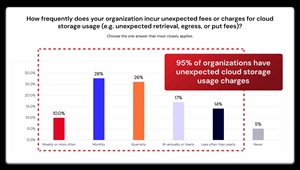 [Click on image for larger view.] Hidden Fees Are Everywhere (source: Backblaze)
The types of surprise costs most often cited include retrieval, egress, and PUT fees. These are the charges that typically arise when organizations access or move data stored in the cloud, often leading to budget variances that IT teams did not anticipate during procurement. Backblaze said the findings highlight the extent to which storage billing complexity remains a problem, even as cloud adoption has become central to IT operations across industries.
In response to these unplanned costs, 85% of organizations reported taking steps to manage the impact. More than half — 56% — said they are reducing the size of datasets stored in the cloud, while 45% are shortening storage duration policies. Another 40% said they are cutting spending elsewhere in their technology stack to compensate for higher storage costs. These adjustments are designed to create more predictable budgets, but they also limit the amount of data available for analytics, AI, and other high-value workloads. Larger organizations with more than 5 PB of data were especially likely to face frequent surprise charges.
The study identified egress fees — the cost to move data out of a provider's cloud environment — as a central factor in what many respondents described as data lock-in. A majority, 55%, said that egress and data transfer costs were the single biggest barrier to switching cloud storage providers. According to the report, this dynamic has created a "walled garden" effect, in which providers profit from data immobility rather than competition on service quality or innovation. That situation, the report noted, leads to slower cloud adoption, higher total cost of ownership, and limited agility for IT teams attempting to scale modern workloads.
"The data shows what many IT leaders already know from experience: Innovation is being throttled not by technology limits, but by cloud economics via egress fees and unpredictable charges,"
said Gleb Budman, CEO at Backblaze, in a news release. "In a cloud-first, AI-powered world, the question is no longer whether you can afford innovation — it's whether your current cloud provider will let you."
Flexibility and interoperability challenges extend beyond egress costs. Nearly all respondents — 99% — said limited flexibility and lack of interoperability are affecting their ability to deliver and scale digital initiatives. The findings indicate that while data may be secure in the cloud, it is often effectively stuck, difficult to integrate or use across platforms, and expensive to move between systems. For enterprises with complex hybrid or multi-cloud architectures, this friction is a significant constraint on efficiency and performance.
The report suggests that procurement priorities are shifting as a result. Sixty-two percent of respondents said they now prefer to assemble best-of-breed cloud environments rather than rely on one-stop-shop ecosystems. Predictability, transparency, and interoperability were the attributes cited most frequently as factors in provider selection. Backblaze noted that S3-compatible APIs, transparent egress policies, and flat pricing can help address the pain points identified in the survey.
For the full report, visit the Backblaze site (registration required).
About the Author
David Ramel is an editor and writer at Converge 360.