CT at the Show
From high-end collaborative computing to super-eProcurement, higher
ed reaches for new heights.
Sun: Worldwide Ed and Research
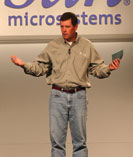
Next-generation developers
With more than half international attendees, about 600 education leaders
met in San Francisco in February for Sun Microsystems’ Annual Worldwide
Education and Research Conference. Sun Chairman and CEO Scott McNealy
spoke about the company’s student developer community program (www.sun.com/edu/student_developer),
donations of processing and storage capabilities to education institutions,
and grants of more than $1 million to build school labs—all efforts aimed
at reducing the digital divide. “Nowhere is the digital divide wider or
deeper than in the area of education,” McNealy said. “We must encourage
and train the next generation of developers to think big and act boldly
no matter what side of the divide they’re on.”
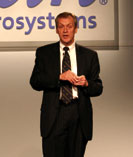
Research is key
A central theme of the conference was supporting innovation and
research. After he addressed the conference University
of California System President Robert Dynes told Campus
Technology, "As a research university, we have to teach young
people how to be creative; only if they are creative will they
be the next-generation leaders. The only way to do that is to engage
them in research, because that is the creative effort. And technology
is the platform by which you create the innovators.
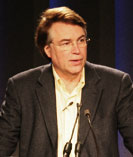
Get ready for the optiputer
Reflecting on Sun's famous assection that "The Network Is the Computer,"
Larry Smarr, UC-San Diego's IT director, introduced his
work (with the California Institute for Telecommunications and
Information Technology) on an optical network computing framework
that could remove bandwidth as an obstacle to high-end collaboration. "Bandwidth
is getting cheaper faster than storage. Storage is getting cheaper
faster than computing. The exponentials are crossing," he said.
SciQuest NextLevel 2005
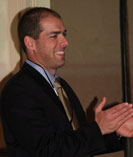
Overcoming eProcurement w'es
At SciQuest's annual meeting in February, keynote Tim Minnahan, a senior
VP of Supply Chain Management for the Aberdeen Group, prescribed a holistic,
total cost management approach to eProcurement in higher ed. Referring
to Aberdeen's recently released study, "The E-procurement Benchmark Report:
Less Hype, More Results" (Aberdenn Group, December 2004; (
www.aberdeen.com). Minahan
offered best practices and strategies to secure successes in a market
where "many efforts to maximize eProcurement return on investment stall
before they reach full potential."
Blending in with ERP
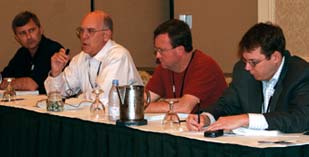
Moderated by SciQuest's VP for Higher Education Dorrian Porter, procurement
powerhouse panel members discussed how they've leveraged technologies
from PeopleSoft/Oracle and SAP into their overall eProcurement strategy.
(Left to right: Chris Mihok, Yale University (CT); Jerry
Fuller, University of Texas Health Science Center-Houston;
Tom Hoole, MIT; Dorrian Porter, SciQuest.
RSA 2005 Security Conference
Studied presentations
Amid the hustle-bustle of exhibits and packed keynotes at RSA 2005,
track sessions homed in on a range of security interests--from identity
management and secure Web services, to blended threats. Several presenters
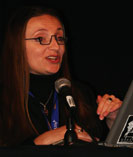
from higher ed participated in panels. Andrea Matwyshyn, an assistant
law prof from Northwestern University (IL), joined a
track on privacy law, and policy.
Security? On Windows?
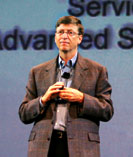
A serious Bill Gates topped the keynote lineup, offering the short-list
version of Microsoft security development efforts--stronger built-in security
for Internet Explorer and v.1 of "the ultimate mail virus protection" for
Windows users that should be delivered by year's end. Microsoft spends
about $6 billion of its R&D budget on security products, Gates noted,
adding that Microsoft software is now running on 90 percent of the worlds
PCs.
Security expo packs 'em
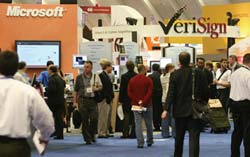
For five full days, attendees crowded the Moscone Center in San Francisco
during February's 14th annual RSA Security Conference and Expo.
International Conference on Technology, Knowledge and Society
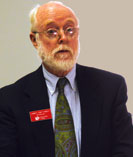
From theorists to practitioners
Keene State College's Homer Stavely provided his "Reflections
on the Nature of Information." Most presentations, like Stevely's, were
highly technical--conference organizers say that next year, they will
boost the number of practioner sessions, giving educators a chance to
show technology applications in action.
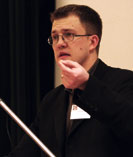
Scholars on technology
The small February gathering of international scholars on UC
Berkeley's Clark Kerr campus marked Common Ground's (commongroundgroup.com)
second annual Technology Conference, featuring multi-faceted discussions
of the impact of technology on society and knowledge systems. In his
plenary session, McGill University's (Canada) Darin
Barney talked about education's role in the changing knowledge economy.
2nd Annual Graduate Cohort for Women
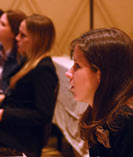
Mentors and netowrks
February's Graduate Cohort Program of the Computer Research Association's
Committee on the Status of Women in Computing Research (CRA-W; www.cra.org),
brought together in San Francisco 220 first- and second-year female grad
students from 73 universities, plus 26 researchers who came to share experiences.
With support from Microsoft, Google, and Lucent Technologies, the program's
goal is to increase success and reduce attrition of woman in the career
path leading from graduate study into computing research.
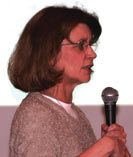
Sharing the knowledge
Presentations covered skills for surviving graduate school, how to build
a solid foundation in the research process, networking and professional
interaction, working with mentors, and more. Mary Jean Harrold, a professor
in the College of Computing at Georgia Institute of Technology .
Offered students advice on getting established in the research process.