VoIP Report Card
A survey of ACUTA conference-g'ers examines the slow march toward voice over IP.
 AT ITS VOIP SEMINAR this past spring in Providence,
RI, the Association for Communications Technology
Professionals in Higher Education asked attendees about their institutions’ adoption of voice
over IP (VoIP). While the sample of 200-plus campuses
wasn’t intended to be a comprehensive survey of higher
education, respondents represented both public and private
institutions, from small colleges to major universities
across North America.
AT ITS VOIP SEMINAR this past spring in Providence,
RI, the Association for Communications Technology
Professionals in Higher Education asked attendees about their institutions’ adoption of voice
over IP (VoIP). While the sample of 200-plus campuses
wasn’t intended to be a comprehensive survey of higher
education, respondents represented both public and private
institutions, from small colleges to major universities
across North America.
Not on the Honor Roll Yet
Only 43 percent of institutions surveyed by ACUTA reported
that they have VoIP networks, and almost all of those
respondents noted that their current VoIP network covers
less than 25 percent of the campus. All institutions with
VoIP networks were asked to grade them. The averaged
response was 3.13—a “B.”
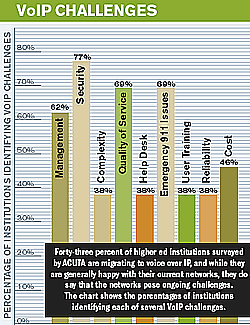
Not bad. But the institutions surveyed that are currently
using voice over IP identified numerous concerns and
ongoing challenges that kept VoIP off the honor roll this
year (see chart, left). Notably, security was listed by
77 percent of respondents as a concern. Quality of service
and emergency 911 issues were each cited by 69 percent.
And 62 percent pointed to management issues.
 Follow the Migration
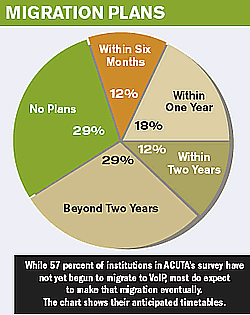
Among the colleges and universities that don’t currently
have voice over IP networks, 71 percent say they have
migration plans in the next six months to two years or more
(see chart, left). Of the institutions that already have
VoIP networks—and most of those have VoIP only on portions
of their campuses—77 percent are planning to
expand their networks.
The takeaway seems to be a message of slow but certain
movement to voice over IP. An anonymous comment
from a survey respondent sums it up best: “Our vendor is
moving in that direction, so we will slowly migrate when it
makes sense.”