CT Solutions
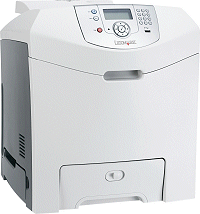
New Laser Printers
Lexmark has introduced two new series of printers: the C530 color laser
series and the monochrome E series. The C530 series (model C534n pictured) includes a new eco-mode function, which minimizes power consumption
and paper waste, and features high-yield 7,000-page color
toner cartridges that lower the cost of printing per page. The E series
includes a quiet-mode function that reduces printing noise and an instant
warm-up function, suitable for classrooms or libraries that need a quiet,
fast monochrome printer. Prices for the C530 series start at $499; the
E series starts at $199.
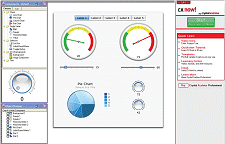
Free Data Visualization App
Business intelligence vendor Business Objects has launched
CX Now!, a lightweight version of its Crystal Xcelsius data visualization
software. CX Now! allows users to transform Excel
spreadsheets into interactive charts and graphs of trends and
projections, audience-friendly presentations of complex data, and
dynamic dashboards that display multiple business variables. The
application can be downloaded for free here.
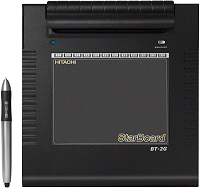
Wireless Presentation Tool
Hitachi Software has announced the StarBoard BT-2G Bluetooth Wireless System tablet, equipped with an interactive pen tool and compatible with StarBoard interactive
T-17SXL and T-15XL panels. An extended range of up to 65 feet and battery life
of 24 hours give presenters extensive roaming capability. Compact tablet weighs about
one pound and features a writing resolution of 1000 lpi, which is twice the resolution
of its predecessor. Price: $295 for tablet; $550 with software.
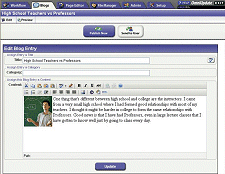
Managing Blog Content
WebsiteASP, a provider of web content management systems (CMS) for
higher ed, has released OU Blogs, a blogging solution that combines the
company’s OmniUpdate CMS solution with the WordPress open source
blog publishing system. Offered as an optional module to OmniUpdate,
OU Blogs allows entries in WordPress blogs to be monitored for appropriate
content, using OmniUpdate’s workflow and approval system. E-mail
notification is automatically sent when blog entries are ready for approval. Pricing starts at $5,000.
On-Demand Digital Media
Cdigix, a provider of digital media services to the college marketplace, has announced Clabs 2007, the latest version
of its digital media educational platform. New features include: Clabs Library, a repository of more than 125,000 video
titles, with a search interface that allows university administrators to purchase media for processing into their own Clabsservice; Clabs Podcasting, allowing campus-produced content to be posted into Clabs in MP3 or MPEG-4 format; and
Clabs Community, enabling a participating university to post institution-owned media into a shared pool that is available
to other Clabs partner institutions. Pricing includes a yearly license and one-time per-title encoding fee, based on
the volume of titles per year.

Tracking Camera and Microphone Array
Unified collaborative communications vendor Polycom has introduced the PowerCam Presenter, a wireless tracking camera
solution, compatible with any videoconferencing system, that uses patent-pending ultrasonic technology
to wirelessly track, automatically focus, and zoom in and out as an instructor moves around the room.
Additionally, Polycom’s new HDX and VSX Ceiling Microphone Arrays provide 360-degree room coverage
and stereo audio from a single array. Together, the solutions enable freedom of movement
for instructors in distributed learning environments.
MSRP: $7,999 for the PowerCam Presenter; $1,195
for the microphone arrays.
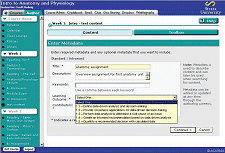
Content Authoring
eCollege, a provider of value-added information services,
has announced the upcoming release (in phases, beginning
this winter) of Content Manager v3.0, the latest version
of its solution for centrally managing, standardizing,
and reusing content across multiple programs, courses,
and sections. Advancements include: selective publishing,
allowing faculty and administrators to change and update
content items for future terms without affecting current
course content; added roles for rights functionality, providing more options for assigning course development responsibilities;
and version control, easing the content authoring and editing process. Priced per enrollment.