2007 Campus Technology Innovators: Podcasting
TECHNOLOGY AREA: PODCASTING
Innovator: University of Connecticut
Sophisticated use of podcasts, precasts,
and postcasts to enhance course material
and facilitate learning
University of Connecticut Professor David Miller
wanted to develop podcasts that would do more than
simply record actual lectures; he wanted to give students
in his large (315-student) General Psychology course
an opportunity to interact with him, with one another, and
with a broader community. "As the first person to incorporate
podcasting into courses at the University of Connecticut in
fall 2005, I decided not to simply 'coursecast,'" he says.
"Though there are times when coursecasting may be useful, I
felt that there was nothing particularly novel about recording
lectures. Creating this simple record was not my main purpose
for podcasting."
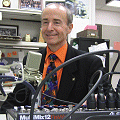
U CONN’S MILLER uses
podcasting to give students
an opportunity to interact
with
him, with one another,
and with a broader community.
Instead, he developed iCube, a weekly one-hour discussion
of course material in which students meet with him, discuss
psychology, and record the session as a podcast. The idea
began as a way to make an exam review session accessible
to all students in the class, but soon expanded into an informal
group discourse that helps students get further engaged
in psychological science. "We not only discuss course material,
but also any other topics of interest related to psychology,"
explains Miller. "Some students have even switched to
psychology because of their active participation." But students
benefit on a personal level as well as academically:
"Students who participate in the recordings get to know me
very well, and vice versa. Some become my advisees; all are
in a great position to get meaningful letters of recommendation
from me," he notes.
Technology choices. Miller uses four Marshall MXL 990 condenser microphones and an Alesis MultiMix 12 FireWire mixer connected to his
Power Mac G5 to record his iCube sessions;
the WireTap Pro application from Ambrosia Software captures the audio feed from the mixer. He
then edits the files using Sound Studio 3 from Freeverse, mostly to eliminate silent passages and adjust
audio levels with a compression filter. Then he converts the file
to MP3 format, uploads the file to his server, and updates an
RSS feed (using The Podcast RSS Buddy, shareware developed
by Chris Tolley that generates RSS feeds in XML format), so that the podcast will
be accessible not only on his iCube website,
but also on iTunes and other podcast aggregators.
Pre- and postcasting. In addition to his successful iCube
podcast series, Miller has further enhanced his courses with
precasts and postcasts. "Precasts are enhanced podcasts
that I produce using ProfCast software [from Humble Daisy], which allows me to incorporate visual
components from PowerPoint presentations," explains
Miller, who uses the precasts to give students a heads-up, in
advance, on important points to look for in an upcoming lecture.
"Just before class, I also play the precast associated with
the upcoming lecture, for students who arrive early."
After class, Miller uses an Edirol R09 portable recorder
from Roland to create short audio recordings
(postcasts) in which he addresses particularly difficult
concepts that were discussed that day. "Every professor has
experienced times when he or she feels that material could
have been explained more clearly during a lecture," he says.
Postcasts allow him to do just that, on the fly—without setting
up his mixer and microphones.
Advice. "My main piece of advice regarding any form of technology
is to think first about how the technology will enhance
your course," says Miller. "How will it facilitate learning? Do not
use it simply because it's available or cool, or because your
peers might be using it. Think: How will it work for you, for your
students, in your course, in terms of an actual enhancement?
Then, try it out. And if it's not working, modify it."