CT Briefs
:: NEWS
HELLO STANFORD? A suite of
five software applications developed to
run on Apple's
iPhone is now being tested at Stanford
University (CA). Two of the apps
enable students to manage course registration
and bills. The other three will
allow users to access Stanford's
searchable campus map, get team
scores and schedules, and check listings
in StanfordWho, the university's
online directory. The university contracted
with Terriblyclever Design, a startup
company in San Francisco co-founded
by Stanford student Kayvon Beykpour,
to develop the suite of applications
under the university's iApps Project.
Read more here.
UW STREAMLINES DATA
ACCESS. The University of Washington will use Microsoft's Amalga, a unified
intelligence system, to offer researchers
simplified access to data that may currently
be scattered-- and possibly very
difficult to unearth-- throughout the
university's vast information systems.
The Amalga platform will focus on
helping healthcare and clinical professionals
at UW reach critical data
quickly, avoiding common delays.
UCSD PLANTS SOLAR TREES.
The University of California-San
Diego is taking a novel approach to
generating sustainable energy on its
campus, by transforming its parking
garages into solar power plants.
With the help of Envision Solar, the university
is "planting" solar trees on the
roofs of two of its parking structures to
generate electricity for the campus and
provide infrastructure for supporting
electric vehicles. According to Envision,
each of the solar trees, which use
Kyocera photovoltaic
modules, will generate "17,000
hours of clean energy per year, which is
enough to power more than four
single-family homes." The company
also says that each tree
saves about 13.2 metric tons of
carbon emissions. Read more here.
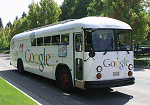
THE GOOGLE APPS FOR EDUCATION bus brought tech experts
and demos to 10 campuses across the US.
DRIVING GOOGLE
APPS FOR EDUCATION.
At the beginning of the
school year, Google made a 5,000-
mile road trip across the US
to visit 10 college campuses,
beginning with Southern California's
USC and ending with
Northwestern University (IL). To
make the journey in style, the company
converted a 30-year-old bus to biodiesel,
updated it with solar panels and other
green features, stocked it with tons of
technology and wireless internet, and
gave it a "Google" paint job. Of course,
the bus was chock-full of Google Apps
for Education demos and tech experts
(riding along or flying to meet the bus)
with new ideas to discuss with students
and faculty. Read more here.
UMICH AND DTE: CLEAN
ENERGY PRIZE. This school year,
a new competition is challenging
teams from Michigan colleges and
universities to develop the best business
plans for bringing new clean-energy
technologies to market.
Organized by DTE Energy and the University
of Michigan, the Clean Energy
Prize challenge will
award $100,000 in prize money during
spring 2009 in an effort to help draw
emerging technologies out of university
labs in Michigan and into the commercial
space. Read more here.
NATIONAL CRM. The National University
System has elected to replace
the constituent relationship management
module of its ERP system with Talisma's CRM system.
Administrators will deploy and configure
Talisma's solution across all of
National's affiliate institutions, including
National University (CA), National
Polytechnic College of Science (CA),
Spectrum Pacific Learning Company, and others.
RECRUITING METRICS. At Seton
Hall University (NJ), marketers are
using a web-based service from Coremetrics to
gather and manage data on long-term
recruitment campaigns that may include
communications or transactions through
numerous channels. "Our recruitment
cycle is a long one, often taking as
much as 18 to 36 months from the initial
inquiry to enrollment in classes,"
says Robert Brosnan, director of web
and digital communications. "Coremetrics
gives us one place to go to get all
the data we need."