NEC Rolls Out 2 Short-Throw LCD Projectors
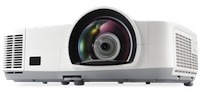
NEC's NP-M300WS has a throw ratio of 0.48:1 and features automatic keystone correction. |
NEC has introduced two portable, networkable LCD projectors as the newest members in it's M-series of short-throw projectors.
The new projectors, the NP-M300XS and the NP-M300WS, can quickly switch between multiple computer inputs due in part to two 15-pin D-sub ports built into back of each model. In addition to supporting multiple analog sources, the projectors also accepts video from HDMI sources and supports displaying images via USB sources.
The NP-M300XS offers a native resolution of 1,024 x 768 (XGA) and maximum projected screen size 110 inches, while the NP-M300WS features a native resolution of 1,280 x 800 (WXGA) and a maximum projected area of 104 inches. Both models feature a brightness of 3,000 lumens, a contrast ratio of 2,000:1, a throw distance ranging from 1.8 feet to 3.6 feet, and support for video resolutions up to 1080p.
For networking and communications, the projectors offer RJ-45 connectivity and RS-232 control. Wireless LAN connectivity is optional.
Other features include:
- A throw ratio of 0.48:1;
- An automatic keystone correction ±20 degrees;
- A 1.2x zoom lens;
- A 10 watt speaker.
Ports include two 15-pin mini D-sub, HDMI, S-video, composite video, stereo minijack, a 15-pin D-sub video out port, and variable audio out. Both projectors weigh in at 8.8 lbs. and measure 15.7" x 12.2" x 5.5".
The NP-M300XS is currently available for $999, while The NP-M300WS ships for $1,099. Both projectors are covered by a two-year parts and labor and a one-year or 500-hour lamp warranty.
Further information on the NP-M300XS is available here. More information on the NP-M300WS can be found here.
About the Author
Dan Thompson is a freelance writer based in Brea, CA. He can be reached here.