ViewSonic Debuts 3D-Ready Classroom Projectors
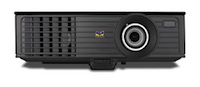
The new models in the Viewsonic PJD-series of DLP projectors offer resolutions up to 1,280 x 800. |
ViewSonic has unveiled three 3D-ready DLP-based projector's for classrooms.
The new projectors, the PJD6253, the PJD6223, and the PJD6553w, display images ranging from 30 inches to 300 inches (diagonal) and offer a dynamic contrast ratio of 4,000:1. All three offer 30-bit color depth.
The PJD6253 and the PJD6223 have a native resolution of 1,024 x 768 (XGA), while the PJD6553w has a native resolution of 1,280 x 800 (WXGA). Brightness ratings for the units include 2,700 lumens for the PJD6223 and 3,500 lumens for both the PJD6253 and the PJD6553w.
The projectors support a wired LAN connection and come equipped with both Crestron e-Control, an IP based control system that enables remote control via browser, and Crestron RoomView express, a solution that can remotely monitor compatible AV equipment in up to 250 rooms. RS-232 control is also supported by the projectors.
Additional features of the PJD6253 include:
- 1.3x optical zoom lens;
- 240 watt lamp;
- An economy mode that can extend the unit's estimated lamp life from 3,500 hours to 5,000 hours;
- 10-watt speaker; and
- A throw ratio of 1.51 to 1.97:1.
Features of the PJD6223 include:
- 1.1x optical zoom;
- A 180 watt lamp;
- An economy mode with the ability to extend the estimated lamp life from 4,500 hours to 6,000 hours;
- 10-watt speaker: and
- A throw ratio of 1.86 to 2.04:1.
Features of the PJD6553w include:
- 1.3x optical zoom lens;
- 240 watt lamp;
- An economy mode that can extend the unit's estimated lamp life from 3,500 hours to 5,000 hours;
- 10-watt speaker: and
- A throw ratio of 1.21 to 1.57:1.
The projectors measure 3.3" (h) x 11.6" (w) x 9.5" (d) and weigh 5.7 pounds.
AV inputs for all three models include HDMI, two analog RGB/component (mini D-sub 15-pin), S-video, composite, and two stereo minijacks. AV outputs include analog RGB (mini D-sub 15-pin monitor out) and a stereo minijack. Control and peripheral ports include RJ-45, RS-232, and USB.
The PJD6253 currently ships for $599, the PJD6223 for $709, and the PJD6553w for $749.
Further information is available at viewsonic.com.
About the Author
Dan Thompson is a freelance writer based in Brea, CA. He can be reached here.