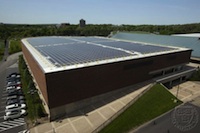
Harvard Adds 600 kW Rooftop Solar Array

600 kWh Rooftop Solar Array
Source: Jon Chase, Harvard staff photographer

As part of its goal to decrease institutional energy usage by 30 percent in the 10 years between 2006 and 2016, Harvard University has just installed the largest solar project on campus. Working with Borrego Solar Systems, the university placed 2,275 solar photovoltaic panels on an acre and a half of roof space on the Gordon Indoor Track and Tennis Building. The project took six weeks and is expected to generate about 590 kilowatts of electricity.

The electricity produced will be delivered to the university's own electrical grid. The project is expected to pay for itself within six to 10 years. Borrego specializes in building solar projects for commercial and public sector organizations.

  Harvard's three-minute time-lapse video of the latest installation.
 

While this is the largest energy generation project undertaken by Harvard, over the last several years, the university has implemented numerous other initiatives to reduce or create energy through alternative means. In 2009 a solar installation that generates up to 501 kilowatts went on top of a retail center owned by the university. A 2010 solar thermal and steam heat recovery system was put in on top of other facilities to generate the majority of domestic hot water for buildings in Harvard Yard.

Other solar projects have been placed on additional rooftops throughout campus.

About the Author

Dian Schaffhauser is a former senior contributing editor for 1105 Media's education publications THE Journal, Campus Technology and Spaces4Learning.

Featured

  • Hootsuite

    Beyond the Feed: How Higher Ed Turns Social Media Into a Measurable Enrollment Engine

    More than half of prospective students research programs on social media before visiting a university website, and nearly half will skip applying to a school that looks inactive online. Hootsuite, the all-in-one social OS platform trusted by more than 2,000 higher education institutions, helps campus teams turn everyday posts into measurable outcomes, from applications to alumni giving.

  • A glowing digital brain with neural connections and light trails

    AI Giants Warn It May Be Time to Slow Down

    For years, leaders in the artificial intelligence industry have warned that increasingly capable AI systems could eventually become dangerous, all the while continuing to race to build them. Now, their sentiments have changed.

  • lock icons, shields, and glowing data paths

    Research Studies Suggest AI Is Accelerating Familiar Cyber Attacks

    Research released around the recent Black Hat USA 2026 conference suggests that artificial intelligence is increasing the speed and scale of cybersecurity activity without replacing the attack methods defenders already face.

  • digital brain with network connections

    Microsoft Moving to Internally Developed AI Models in Office Apps

    Microsoft is reportedly using its own in-house artificial intelligence models to handle some workloads in Excel and Outlook, offering new evidence that the company is moving its AI strategy beyond model development and into large-scale cost reduction.