NSF Awards $12 Million to Redesign Undergraduate Engineering and Computer Science Education
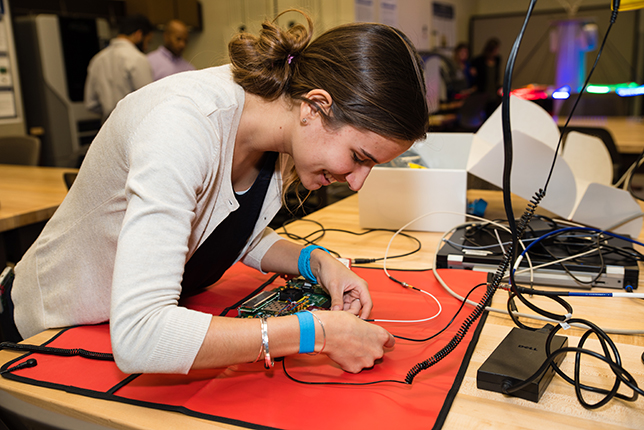
A student works on a circuit board project at the University of San Diego, one of six institutions selected for an NSF RED award. (Photo courtesy of University of San Diego)
Engineering and computer science programs at six higher education institutions will get a big revamp thanks to $12 million in funding from the National Science Foundation. The NSF Directorates for Engineering, Computer and Information Science and Engineering, and Education and Human Resources have jointly awarded six five-year, $2 million grants to "help universities substantially improve the professional formation of engineers and computer scientists — the formal and informal processes and value systems by which people become experts in these fields," according to a press release.
"The engineering and computer science professions have a large potential to address national priorities and societal grand challenges," said Pramod Khargonekar, NSF assistant director for engineering, in a statement. "To flourish in the future, engineering and computer science must attract and retain people from all sectors of society."
A key part of the grants is support for revolutionizing engineering departments, an NSF program known as RED. RED projects "build upon successful innovations in the introductory and capstone years to improve the entire undergraduate experience, including technical core courses during sophomore and junior years, extracurricular professional activities and student transfer from two- to four-year institutions." They can also involve "faculty development, faculty incentives and inclusive academic cultures."
"An underlying premise of RED is that department heads can be critical levers for change," said Donna Riley, NSF program director for engineering education research, in a statement. "RED focuses on transforming department structure and faculty reward systems to stimulate comprehensive change in policies, practices and curricula."
This year's grant recipients:
- Anil Bajaj and co-investigators Edward Berger, Elizabeth Briody and Edward Morrison will focus on the Purdue University mechanical engineering department with the project "An Engineering Education Skunkworks to Spark Departmental Revolution";
- Anthony Maciejewski and co-investigators Zinta Byrne, Thomas Chen and Michael De Miranda will focus on the Colorado State University department of electrical and computer engineering with the project "Revolutionizing Roles to Reimagine Integrated Systems of Engineering Formation";
- Mary Lou Maher and co-investigators Bojan Cukic, Celine Latulipe, Jamie Payton and Steven Rogelberg will focus on the University of North Carolina at Charlotte computer science department with the project "The Connected Learner: Design Patterns for Transforming Computing and Informatics Education";
- Ann McKenna and co-investigators Samantha Brunhaver, Shawn Jordan, Nadia Kellam and Micah Lande will focus on the Arizona State University Polytechnic School's department of engineering and manufacturing engineering with the project "Additive Innovation: An Educational Ecosystem of Making and Risk Taking";
- Chell Roberts and co-investigators Michelle Camacho Ming Huang, Susan Lord and Rick Olson will engage the University of San Diego school of engineering (including departments of electrical, industrial and systems, and mechanical engineering) in the project "Developing Changemaking Engineers"; and
- James Sweeney and co-investigators Michelle Bothwell, Milo Koretsky, Devlin Montfort and Susan Nolen will focus on the Oregon State University department of chemical, biomedical and environmental engineering with the project "Shifting Departmental Culture to Re-Situate Learning and Instruction."
The next RED call for proposals is planned for FY 2016. For more information, visit the NSF site.
About the Author
Rhea Kelly is editor in chief for Campus Technology, THE Journal, and Spaces4Learning. She can be reached at [email protected].