New Vernier System Allows Students To Perform Physics Experiments
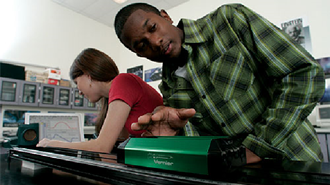
The new system of carts and friction pads will let students do their own physics experiments.
Vernier
Software & Technology has introduced a
new system of carts and friction pads intended to help students perform
hands-on
experiments in order to learn physics concepts.
Vernier's Dynamics
Cart and Track System allows students to explore kinematics,
dynamics, momentum
and energy. Each system includes a track, two carts, an ultra pulley
and all of
the necessary attachment accessories. The systems can also be easily
adapted to
study optics, color and diffraction.
The two new carts — a standard
cart and a plunger cart — can be reconfigured for different experiments
by
attaching various sensors and using magnets or spring-loaded plungers.
Side
mass trays make it possible to adjust total mass.
The stand-alone system will
retail for $239. For $384, students can also get a Vernier Motion
Encoder
System that captures more motion data than a traditional ultrasonic
motion
detector. Other accessories that can be purchased separately include a
bumper
and launcher kit, fan cart, friction pad and an entire options
ecosystem.
The new system is
particularly suitable for studying Newton's second law, acceleration on
an
inclined plane and conservation of momentum.
"This new next-generation
system helps students conduct engaging, hands-on investigations while
learning
key physics concepts," said Vernier Software and Technology CEO John
Wheeler. "Improving
upon the design of our current dynamics system, the new technology
provides
both teachers and students with an extremely durable, flexible and
customizable
solution to collect and analyze a wide variety of physics-related data."
About the Author
Michael Hart is a Los Angeles-based freelance writer and the former executive editor of THE Journal.