InCommon Extends Trust Services Internationally
InCommon member organizations now have single sign-on privileges with higher education institutions, research organizations and corporations in 38 other countries.
The U.S.-based trust and identity infrastructure provider InCommon has joined the eduGAIN global service, giving its U.S.-based members the convenience of single sign-on interaction with higher education institutions, research organizations and corporate service providers in 38 other countries.
Organizations like InCommon and eduGAIN provide a common trust framework for education and research that allows different entities to share online access to their resources. InCommon is a function of Internet2, a community of academic, research, government and industry entities that undertake research and development in technology areas for the benefit of all their members. Until the agreement with eduGAIN, InCommon's member affiliates were limited to accessing each other's services in the United States.
Participants in this kind of trust framework often lack the resources to implement federated identity solutions but can benefit from simplified access to shared online services. Along with providing access to vast research and education resources, in the long term such usage could help reduce staff, lower service integration costs, increase security and give students ease of access.
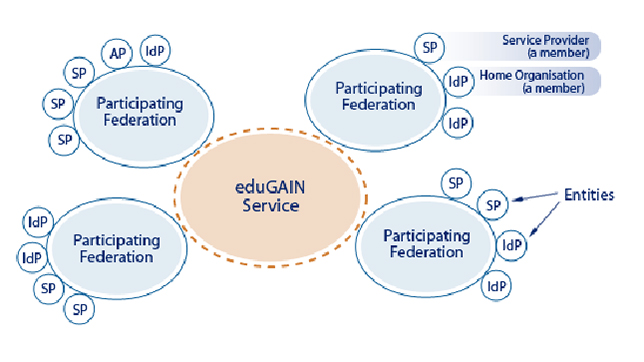
EduGAIN's infrastructure services
With the new international service, university faculty, students and researchers can use their home credentials to access:
- Online journals and database that other participating federations have;
- International tools for analyzing and sharing data; and
- Services offered through other national federations.
Each national federation, like InCommon in the U.S., has a trust registry (sometimes described as the digital version of a large phone book) that compiles all the resources available in member colleges, universities and companies. Each of the now 39 federations sends that "phone book" to eduGAIN, which combines them and republishes them as a single large file.
This allows researchers from all over the world to take advantage of research not otherwise available to them before. As an example, research partners from many countries are able to participate in large projects like the Laser Interferometer Gravitational-Wave Observatory. On a smaller scale, Brown University's Center for the Study of Slavery and Justice includes partners from Europe and Africa.
"InCommon joining eduGAIN is a major milestone for the research and education community," said Steven Carmody, an IT architect at Brown and chair of the InCommon Technical Advisory Committee, "and a sign of its maturity and evolution toward essential infrastructure."
About the Author
Michael Hart is a Los Angeles-based freelance writer and the former executive editor of THE Journal.