Moodle Intros Full Support for Competency-Based Ed
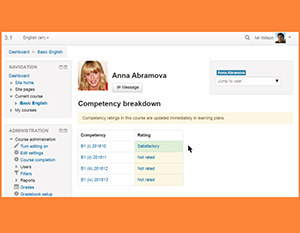
The flagship feature of Moodle 3.1 is support for competency-based education.
Open source learning platform Moodle today released version 3.1, which introduces new features for competency-based education. "With Moodle 3.1, administrators can create learning plan templates and apply them to individuals or entire cohorts of students," according to a press release. "Competency frameworks and learning plans can now be constructed within Moodle or imported from external sources using a plugin."
Other highlights of Moodle 3.1 include:
- Revamped assignment grading interface, which presents all elements on one screen and gives instructors the ability to annotate over student submissions of different file types;
- Ability to bulk download files in zipped folders for offline use;
- Ability to pin forum discussions, making them more visible to students;
- Publish as LTI tool, for allowing remote users to access selected courses and activities;
- Tagging for course activities and resources;
- In-line editing;
- Global search and file system repository search functions;
- Workshop enhancements;
- Assignment file conversion;
- Learning plan templates; and
- Lesson default settings.
In addition, a new recycle bin feature allows users to restore deleted courses and files to their original locations. This is the first feature contributed by the new Moodle Users Association, a community-driven group focused on giving users a say in Moodle product developments.
For full details on version 3.1 improvements, head to the Moodle site. Moodle 3.1 is available as a free download, via the MoodleCloud service or through certified Moodle Partners.
About the Author
Rhea Kelly is editor in chief for Campus Technology, THE Journal, and Spaces4Learning. She can be reached at [email protected].