Google I/O 2017: Standalone Google VR Headsets from HTC, Lenovo Coming Soon

One of the major drawbacks to using virtual reality (VR) headsets is being tethered to a smartphone or PC while immersed in an experience. However, yesterday at the annual Google I/O 2017 developer conference, Google unveiled an upcoming “revolutionary” standalone VR headset that aims to change that. The headset will be manufactured by HTC and Lenovo.
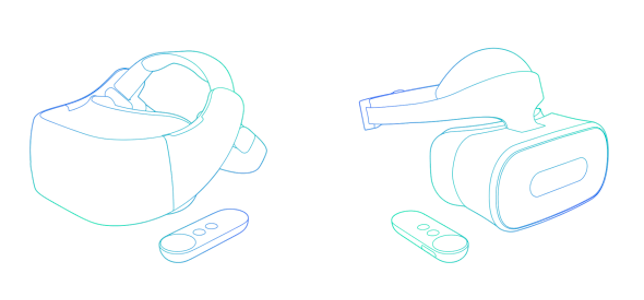
Prototypes of the upcoming Daydream-compatible headsets from HTC (left) and Lenovo (right). Images: Google.

The Daydream-compatible standalone headsets will utilize Qualcomm’s Snapdragon 835 VR platform and what Google is calling “WorldSense” technology, powered by its own Tango augmented reality system. On-board sensors in the headsets will enable inside-out tracking, which will remove the need to connect to any external hardware. Prices and release dates are to be determined.    

Read More

Clay Bavor, vice president of virtual and augmented reality at Google, wrote an essay on Medium that explains WorldSense in more detail.

The Daydream VR platform was introduced at last year’s I/O conference and already there are more than 150 VR apps in the Google Play Store. Google has been working on its standalone VR headset for more than a year.

To learn more about how WorldSense works, watch the video below.

About the Author

Sri Ravipati is Web producer for THE Journal and Campus Technology. She can be reached at [email protected].

Featured

  • InCommon Academy in action with an Advance CAMP unconference activity at the Internet2 Technology Exchange

    Community-Driven IAM Learning with Internet2's InCommon Academy

    Internet2's InCommon Academy Director Jean Chorazyczewski examines how the academy's community-driven identity and access management learning opportunities support CIOs, IT leaders, and their IAM teams in R&E.

  • businessman juggling cubes

    Anthology Restructures, Focuses on Teaching and Learning Business

    Anthology has announced a strategic restructuring, divesting its Enterprise Operations, Lifecycle Engagement, and Student Success businesses and filing for Chapter 11 bankruptcy in an effort to right-size its finances and focus on its core teaching and learning products.

  • Jasper Halekas, instrument lead for the Analyzer for Cusp Electrons (ACE), checks final calibration. ACE was designed and built at the University of Iowa for the TRACERS mission.

    TRACERS: The University of Iowa Leads NASA-Funded Space Weather Research with Twin Satellites

    Working in tandem, the recently launched TRACERS satellites enable new measurement strategies that will produce significant data for the study of space weather. And as lead institution for the mission, the University of Iowa upholds its long-held value of bringing research collaborations together with academics.

  • Hand holding a stylus over a tablet with futuristic risk management icons

    Why Universities Are Ransomware's Easy Target: Lessons from the 23% Surge

    Academic environments face heightened risk because their collaboration-driven environments are inherently open, making them more susceptible to attack, while the high-value research data they hold makes them an especially attractive target. The question is not if this data will be targeted, but whether universities can defend it swiftly enough against increasingly AI-powered threats.