Top 3 Trends to Impact Community Colleges by 2021
Education technology is one of three "emerging trends" poised to impact the United States community college market from 2017-2021, according to a new report from Technavio. The market research firm defines an emerging trend as "a factor that has the potential to significantly impact the market and contribute to its growth or decline."
Technavio predicts consistent growth for United States community colleges, "as these colleges play a critical role in enhancing the employment-oriented skills of employees and preparing them for the rigors of the job market," according to a company statement. "Colleges have evolved and adapted during times to fulfill emerging demands of students and learners. They act as the center of imparting education to students with diverse needs and backgrounds at a lower cost than their counterparts."
The firm's education research analysts identified three emerging trends in the community college market:
1) Emphasis on Education Marketing Services
Community colleges are increasingly taking advantage of services from education marketing providers, in part due to "rising competition in terms of attracting and recruiting students from four-year and for-profit institutions along with quality enhancement initiatives," according to Technavio. "The marketing departments in colleges are looking for innovative ways to reach out a vast array of students," said Jhansi Mary, lead analyst for research on K–12 and higher education, in a statement.
2) Education Technology Penetration
More community colleges are incorporating ed tech products in an effort to improve the quality and affordability of their programs, said Jhansi. "They have adopted [the] online medium of delivering knowledge to their students and are planning to enhance their services to attract and retain students."
3) Growing Demand for Middle-Skill jobs
Technavio has observed a surge in demand for "middle-skill" fields, such as technicians, police, electricians, firefighters, plumbers, welders, dental hygienists, respiratory therapists, radiologic technicians and others — jobs that often require specialized training rather than a traditional bachelor's degree. "Middle-skill jobs are essential for the US infrastructure development and overall economic growth," the researchers reported. "There is a growing demand for such jobs among millennials that have suffered from unemployment issues despite their graduation degrees. As these jobs cannot be outsourced, it is essential that there is great demand for specialized skills required for these jobs."
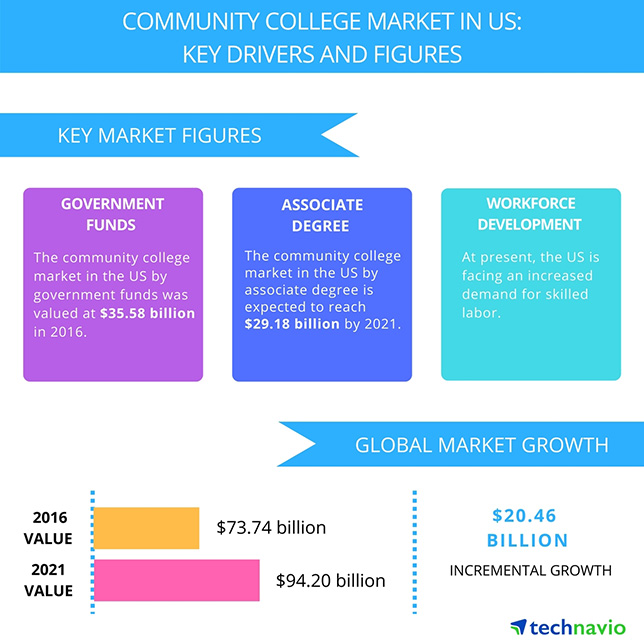
Graphic: Business Wire
The full report is available for purchase on the Technavio site.
About the Author
Rhea Kelly is editor in chief for Campus Technology, THE Journal, and Spaces4Learning. She can be reached at [email protected].